Docs / Developer / The canonical superset model
The canonical superset model
Every format converts through one canonical superset model, never format to format directly
(architecture.md, "The one idea: hub and spoke"). This page is the model itself: the wrapper every
entity shares, and the one rule that decides what its body may contain, the superset rule. For the whole
engine (hub-and-spoke, adapters, detection, escrow mechanics), see architecture.md.
For a specific kind's body shape and how it applies this rule, see the entity pages, starting with
entities/character.md and entities/lorebook.md.
The model is defined in src/core/canonical.ts. The comment at the top names the split this page turns on:
the STRUCTURE (wrapper, original, per-app profiles, format ids) is the stable spine; the per-kind field
details live in src/entities/<kind>/schema.ts (canonical.ts:1-5).
The wrapper
CanonicalEntity<Kind, Body> is the stable shape every entity shares, whatever its kind (canonical.ts:70-81):
| Field | Type | What it is |
|---|---|---|
schemaVersion |
"1" |
The single canonical version, CANONICAL_SCHEMA_VERSION (canonical.ts:13,71). |
kind |
closed union | The entity kind: character, lorebook, persona, or regex today (canonical.ts:70,72). |
id |
string |
A stable storage-safe slug minted from the name by one owner, canonicalId (canonical.ts:23-36,73-74). |
body |
Body |
The content in the superset shape. The superset rule governs what lives here (canonical.ts:75-76). |
profiles? |
Record<FormatId, Partial<Body>> |
Sparse per-app overrides: author once, set only what differs (canonical.ts:61-67,78). |
original? |
Record<FormatId, OriginalEntry> |
The escrow envelope: lossless carry of source-format specifics (canonical.ts:38-51,80). |
FormatId is an open string on purpose: a drop-in adapter folder can claim any id, and the core never
hardcodes the set of formats (canonical.ts:8-11). id is not that: canonicalId normalizes the name to
NFKC, lowercases, collapses non-letter/number runs to single hyphens, caps length, and falls back to"character" when empty, so every adapter mints ids the same way and the result always passes the studio's
path policy (canonical.ts:23-36).
kind is a small closed union. Four kinds are adapter-backed today, the four members of FormatAdapter
(adapter.ts:62-106); two more canonical schemas, preset and pack, are defined under src/entities/
without an adapter yet (architecture.md, "The canonical entity"). Formats are open, entity kinds are
closed: a kind grows only by adding a union member here plus a sibling entities/<kind>/ folder, which is
the trade that buys compile-time safety across the engine (adapter.ts:99-106).
The superset rule
The body is a superset: the union of what all real formats express, not any one format's shape
(architecture.md, "The superset rule"). One rule decides what earns a place in it.
A field earns a first-class canonical slot only if some real wire format serializes it (lorebook/schema.ts:15).
Put the other way: only fields a real, currently-supported format actually produces are first-classed;
everything else rides in original (character/schema.ts:5-7). The rule has two edges, and both are
load-bearing.
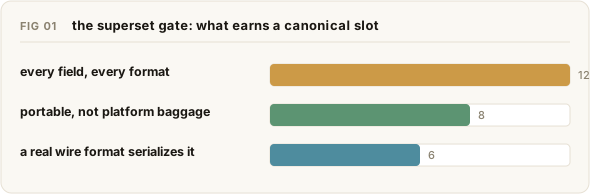
Not serialized means no slot. Two things fail this edge and stay out of the body:
- Platform and database baggage. Creator, stats, publishing status, fork lineage, versioning, timestamps,
token counts, and per-session runtime state are not portable format content, so they rideoriginalor
the entity wrapper, never the body, exactly as the character body strips its own DB fields
(lorebook/schema.ts:9-12). - In-memory-only residue. Fields a running app holds but no serializer ever writes stay out. In the
lorebook body the concrete set is RoleCall'sallowRecursion,scanPreset, andprobabilityMode,
verified absent from both the RoleCall and the SillyTavern serializers, so they rideoriginal(lorebook/schema.ts:15-18). First-classing a field nothing serializes is dead surface.
Single-platform is not a reason to relegate. The gate is "does any real wire format serialize it",
not "do many". An authored field that even one format serializes earns a slot, because the schema is the
editor and an editable slot must map to something a format can carry (lorebook/schema.ts:19-20). The
lorebook body first-classes several fields only SillyTavern produces on exactly this ground: its extra scan
sources (matchCharacterDepthPrompt, matchCreatorNotes), the vectorized / group-override /
group-scoring toggles, the automation binding, and the distinct displayIndex axis, because each is a wire
field a creator sets, not runtime residue (lorebook/schema.ts:19-23).
The distinction the rule polices is authored-and-serialized versus derived-or-runtime. A field a creator
sets and a format writes to disk is content; a field an app computes or holds only in memory is not, no
matter how many apps hold it. The character schema states the same gate for its own body: seeded from the
real formats, widened by the format deep-dive, and first-classing only what a real now-tier format produces
(character/schema.ts:4-7).
Escrow: what the rule leaves out
A field failing the superset rule is not dropped, it is contained. Everything the body does not express
rides the escrow envelope, the wrapper's original field, a Record<FormatId, OriginalEntry> keyed by
source format (canonical.ts:38-51). Each OriginalEntry carries the source payload verbatim (raw), the
fields canonical did not express (unmapped), and, for a binary source, the carrier it arrived inside
(sourceMedia), for example a PNG card's authored pixels (canonical.ts:39-48). This is what makes a
same-format round-trip byte-lossless and a cross-format conversion contained-loss by design; the full
mechanics are in architecture.md ("Escrow: lossless round-trips, contained
cross-format loss"). The superset rule and escrow are the two halves of one promise: the body stays a clean
portable union, and nothing outside it is lost.
Profiles: one superset, many apps
The single superset body still lets one entity differ per app without duplication. profiles is a sparse
map of per-app deltas, Record<FormatId, Partial<Body>>, empty by default (canonical.ts:61-67). You
author the entity once and set only the fields you want to differ for a given app; a per-app version is the
canonical body plus that app's overrides, projected by its adapter, never a full duplicate record
(canonical.ts:61-66). Because both profiles and original are keyed by FormatId, the same open
format-id space threads the whole wrapper: what an app overrides, and what it left in escrow.
Source of truth
| Concern | File |
|---|---|
| Canonical wrapper, schema version, id policy | src/core/canonical.ts |
Escrow envelope (original, OriginalEntry) |
src/core/canonical.ts |
| Per-app profiles | src/core/canonical.ts |
| Entity-kind union (the closed set) | src/core/adapter.ts |
| Superset rule, character body | src/entities/character/schema.ts |
| Superset rule, lorebook body (worked example) | src/entities/lorebook/schema.ts |
| Whole-engine context (hub-and-spoke, escrow, detection) | docs/reference/architecture.md |