Docs / Developer / vaud-json format
vaud-json format
vaud-json is bunzai's own native format: the canonical entity
written straight to plain JSON. Every other adapter translates between its app's wire shape and the
canonical model; vaud-json does no translation at all. It serializes the CanonicalCharacter wrapper
itself (schemaVersion / kind / id / body / profiles? / original?, canonical.ts:70-81) and
reads it back unchanged. That makes it the lossless local save and interchange format, the simplest real
adapter in the registry, and proof the drop-in folder pattern works end to end.
id: "vaud-json", labelBunzai native (.json), kindcharacter, container JSON, writes.json.- One codec, one file:
src/formats/vaud-json/index.ts:21-46. Nolorebookvariant exists in this
folder. native: true(index.ts:26): importable and exportable like any other adapter, but never listed as
an external "publish to" platform. The Press room's format picker and the export dialog both skip
adapters flaggednative(src/ui/apps/press/press-core.ts:26,src/ui/components/export-dialog/index.tsx:53).
For the canonical field meanings this format carries, see
entities/character.md. For the hub-and-spoke, escrow, and detection model, see
architecture.md. For the whole matrix of formats, see
FORMAT-SUPPORT.md (FORMAT-SUPPORT.md:23).
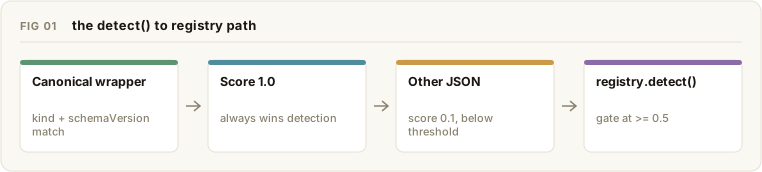
Detection
detect() parses the input through the shared exhaustive canonical runtime schema. It returns 1.0
only for a valid canonical character and 0 for missing text, invalid JSON, unsupported schema
versions, other entity kinds, or malformed bodies. toCanonical() uses the same parser and then
narrows the result to character, so recognition and import share one validation authority.
Field map
There is no wire translation to tabulate. The on-disk JSON is the canonical entity, one to one
(index.ts:43-45):
| Canonical | vaud-json wire |
|---|---|
schemaVersion |
schemaVersion |
kind |
kind ("character") |
id |
id |
body (CharacterBody) |
body |
profiles (per-app overrides) |
profiles |
original (escrow envelope) |
original |
Every field of CharacterBody, the eight always-present sub-objects (identity, persona, prompts,greetings, examples, media, attribution, discovery) plus the optional presentation /settings / bias / worldName / knowledgeRefs / behavior / behaviorRefs / variants, is
written verbatim under body. See entities/character.md for what each field
means; this adapter has no opinion on any of them.
fromCanonical() is JSON.stringify(entity, null, 2) with a suggested extension of json (index.ts:43-45).
It writes the whole entity, including any original and profiles the entity is carrying, with no
filtering or re-projection.
Escrow and round-trip
vaud-json is the one format where "same-format round-trip is lossless" is exact and unconditional rather
than reconstructed from an escrowed twin. Because it serializes the canonical entity directly, a
vaud-json to canonical to vaud-json round-trip returns the identical entity, the same body, and the sameoriginal and profiles untouched (proven by the adapter's own round-trip test, vaud-json.test.ts:22-25,
and by the registry-level round-trip test, registry.test.ts:37-43).
Its relationship to escrow is different from every app adapter, too. The app adapters fill an original
entry keyed by their own id on import, so their private fields survive a same-format round-trip
(architecture.md, "Escrow"). vaud-json neither reads nor writes an original entry keyed to itself: it
carries whatever original the entity already holds straight through, untouched, because toCanonical
and fromCanonical never inspect that field at all (index.ts:9-19,43-45). So a card imported from, say,
SillyTavern and then saved as vaud-json keeps its original.sillytavern.raw intact in the file, ready to
re-project if it is later exported back to SillyTavern.
Quirks
- Detection and import both use
parseCanonicalEntity(). Hand-edited files with unsupported schema
versions, missing required sections, unknown authored keys, or the wrong entity kind fail at the adapter
boundary. Invalid JSON and invalid canonical characters return separate bounded errors. - Pretty-printed output. Exports are two-space-indented JSON (
JSON.stringify(entity, null, 2),index.ts:44), so the file is human-readable and diff-friendly, not minified. - No container, no images inline beyond what the body already holds. vaud-json is pure JSON text; it has
no PNG or zip container. Media rides exactly as the canonicalmediafields encode it (asset refs or
data URIs), unchanged. nativekeeps it off the publish surface and the coverage lens. The Studio's Press room and export
dialog filter on!f.nativewhen building their "publish to" platform lists, and the publish setup
step's own comment says "our own storage format is not a platform" (src/ui/apps/press/press-core.ts:26,src/ui/components/export-dialog/index.tsx:53,src/ui/setup/steps/publish/index.tsx:61). The
Workbench's coverage lens applies the same exclusion one step earlier:/api/coverageonly returns
character adapters wherea.coverage && !a.nativeboth hold (src/ui/server.ts:272-276), so vaud-json,
which is native and has nocoverage.tsof its own, never reaches that list at all, not even as an
undeclared-coverage entry. vaud-json still works as an ordinary import/export target everywhere else,
includingbunzai convertand the Workbench's editing surface.
Source of truth
| Concern | File |
|---|---|
| Adapter (detect / toCanonical / fromCanonical) | src/formats/vaud-json/index.ts |
| Adapter tests | src/formats/vaud-json/vaud-json.test.ts |
| Exhaustive canonical parser | src/entities/runtime-schema.ts |
| Registry (detection threshold, gating) | src/core/registry.ts |
Canonical wrapper, escrow (original), id policy |
src/core/canonical.ts |
Adapter contract (native, coverage, lens) |
src/core/adapter.ts |
Character superset (CharacterBody) |
src/entities/character/schema.ts |
Publish-surface filtering (native excluded) |
src/ui/apps/press/press-core.ts, src/ui/components/export-dialog/index.tsx, src/ui/setup/steps/publish/index.tsx |
| Generated format matrix | docs/FORMAT-SUPPORT.md |