Docs / Developer / Safe rendering: sanitizing card HTML and CSS
Safe rendering: sanitizing card HTML and CSS
This page is the sanitizer spec of record for card-authored markup: the complete allow list and
forbid list for both places the app turns untrusted HTML or CSS into DOM. docs/reference/concepts/safe-rendering.md
covers the same prose-field pipeline from the UX side (the render toggle, the leaving-gate for
links, RenderBox) and is still accurate for that; this page does not repeat it. What that concept
page does not cover is the second, higher-risk surface: behavior.backgroundHTML andbehavior.backgroundCSS, a Risu card feature that carries full author-supplied HTML and CSS, not
prose. The two surfaces run different sanitizer configurations because they sit behind different
boundaries. That difference, and which parts of it are actually verified, is the subject of this
page.
Where card HTML and CSS enter the app
CharacterBehavior carries two optional verbatim strings: backgroundHTML and backgroundCSS
(src/entities/character/schema.ts:303-305). The Risu field mapper reads and writes them
unchanged, no transform in either direction (src/formats/risu/risu-fields.ts:119-120 on import,:220-221 on export). The module's own header comment is explicit that this is the executable
behavior surface, "NOT here and NOT original-forever," carried on the raw twin and flagged at
import via hasExecutableContent until a dedicated behavior entity models it
(src/formats/risu/risu-fields.ts:3-9). Nothing in the canonical model parses or interprets this
HTML and CSS; it rides as data until a render call touches it.
Regex replace effects on a card can also produce a string containing HTML. That output is never
rendered inline either; it is documented to reach the screen only through the same sealed preview
covered below (src/core/regex/apply.ts:13-16).
Ordinary prose fields (description, greeting, creator notes) are a separate, lower-risk case:
markdown or HTML text, tagged per field by RenderFormat, rendered through renderMarkup and
shown with dangerouslySetInnerHTML (src/ui/components/render-box/index.tsx:60-94, thedangerouslySetInnerHTML calls at :66 and :88). No iframe sits between that output and the app
chrome.
Two rendering surfaces, two boundaries
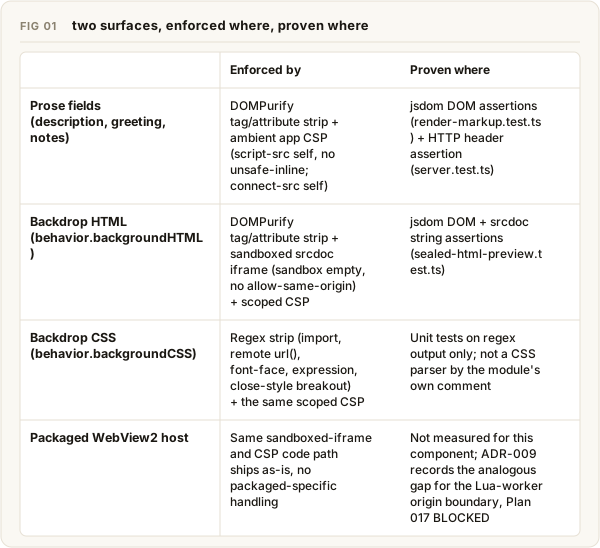
Prose fields (src/ui/_shared/render-markup.ts, consumed by RenderBox) sanitize with
DOMPurify and inject straight into the current document. There is no iframe. The only isolation
this surface has is the app shell's own ambient Content-Security-Policy, described below. Because
there is no per-render sandbox, this config's forbid list has to do the work of blocking
auto-fetch elements outright.
The backdrop preview (src/ui/components/sealed-html-preview/index.tsx, wired tobehavior.backgroundHTML and behavior.backgroundCSS from src/ui/apps/workbench/workshop/code-pane.tsx:54-73)
sanitizes with a narrower DOMPurify config, then loads the result into a srcDoc iframe carrying
its own scoped CSP. The component's own header comment states the design intent plainly:
"Sanitizing is not isolation; the iframe + CSP are the load-bearing egress barrier"
(src/ui/components/sealed-html-preview/index.tsx:3-5).
Both surfaces run DOMPurify last, after any markdown-to-HTML conversion, and both cap input size
before parsing (RENDER_INPUT_CAP 200000 characters in src/ui/_shared/render-policy.ts:20,BACKDROP_HTML_CAP 200000 in src/ui/components/sealed-html-preview/index.tsx:24, BACKDROP_CSS_CAP
100000 in src/ui/components/sealed-html-preview/backdrop-css.ts:9).
What DOMPurify allows and strips
Both configurations set ALLOW_DATA_ATTR: false and add back only target on anchors
(render-markup.ts:113-120, sealed-html-preview/index.tsx:83-87). DOMPurify's default HTML
profile already empties <script> content and strips inline event handlers and javascript: /vbscript: URIs before any project config is applied; both call sites also explicitly forbid thescript tag for clarity and defense in depth. This baseline is exercised directly:render-markup.test.ts asserts a script tag, an onerror handler, an SVG onload handler, and ajavascript: href (as raw HTML and as a markdown link) are all absent from the sanitized output
(src/ui/_shared/render-markup.test.ts:33-52), and a known mutation-XSS payload
(<math><mtext><table><mglyph><style><img ...>) still comes out clean
(render-markup.test.ts:68-72).
Past that shared baseline, the two forbid lists diverge on purpose:
- Prose-field forbid list (
render-markup.ts:31-53):style,script,iframe,object,embed,form,input,button,textarea,select,option,link,meta,base,img,picture,source,video,audio,track,image. Every auto-fetch element (media
tags, the SVG<image>carrier) is removed outright, because this surface has no CSP of its own
to fall back on for network egress; the tag list has to carry that job. This is verified: remote<img>,<picture>/<source>/<video>/<audio>/<track>, and SVG<image>are all confirmed
stripped and no test host string survives (render-markup.test.ts:76-102). - Backdrop-preview forbid list (
sealed-html-preview/index.tsx:26-41):script,iframe,object,embed,form,input,button,textarea,select,link,meta,base,frame,frameset. Notably it does not forbidstyleorimg. That is deliberate, not an
oversight: this surface's scoped CSP (img-src data: blob:,connect-src 'none', next section)
is what is meant to stop any network reference that survives the tag scan, so the tag list is
narrower and the CSP carries the network-egress job instead.
Permitting <style> in the tag list was not, on its own, enough to keep a page's design.DOMPurify.sanitize returns the parsed document's BODY markup, so a whole document's<head><style> went into the bin with the head - every word drew and none of the design did, while
a <style> written inside <body> survived, which made the failure look arbitrary. Every style
block is therefore lifted out before sanitizing (extractStyleBlocks,sealed-html-preview/index.tsx:68-77) and its text is concatenated after any author CSS and passed
through sanitizeBackdropCss - the same function, the same guarantees, one behavior wherever the
block was written. A block left unterminated by the 200,000-character cap is taken to the end rather
than dropped, so a truncated drawing still shows the design of the part that arrived. What follows a
real </style> is ordinary markup and is treated as such: a remote <img> there survives the tag
scan and is stopped by the CSP, exactly as it was before (sealed-html-preview.test.ts).
An afterSanitizeAttributes hook, registered lazily on first render so importing the module never
touches window (render-markup.ts:76-111), does three more things to whatever DOMPurify lets
through on the prose-field path: strips src, srcset, poster, ping, and xlink:href from any
surviving element (FETCH_ATTRS, render-policy.ts:129-135, verified atrender-markup.test.ts:104-112); drops an anchor's href unless it passes isSafeHref (http,
https, mailto, an in-document # link, or a single-slash same-origin path; //host, /\host, \host and
anything with a scheme hidden by leading/trailing controls or spaces or by tab/LF/CR inside it (the checked string is trimmed and stripped of those the way a browser does), javascript: and data:
included, is rejected, render-policy.ts isSafeHref), then pins target="_blank" rel="noopener noreferrer"
on whatever anchor survives (render-markup.test.ts:159-163); and narrows any style attribute to
six presentation properties (text-align, color, background-color, font-weight, font-style,text-decoration) with a value that does not match url(, image-set(, @import, expression(,behavior, -moz-binding, or var( (ALLOWED_INLINE_STYLE_PROPS and UNSAFE_STYLE_VALUE,render-policy.ts:85-106; verified at render-markup.test.ts:120-147).
buildBackdropSrcDoc does not install or call that hook. Its DOMPurify pass relies only on its ownFORBID_TAGS and ALLOW_DATA_ATTR: false for the HTML, and on the CSS sanitizer and CSP described
next for style and network egress. This is a difference in mechanism, not necessarily a gap: DOMPurify
hooks are process-global once registered, so if the prose-field renderer has already run once in the
same bundle before a backdrop preview renders, its hook would also apply to that later call. Nothing
in the codebase guarantees or tests that ordering, so the backdrop path's stated guarantees come from
its own explicit config and the iframe/CSP boundary, never from an assumption about hook order.
CSS: sanitizeBackdropCss is defense in depth, not a parser
behavior.backgroundCSS (passed as the css prop, distinct from any <style> tag that might
survive inside backgroundHTML itself) goes through sanitizeBackdropCss
(src/ui/components/sealed-html-preview/backdrop-css.ts). Its own header comment states the
limits plainly: "Defense in depth only: sealed-preview CSP is the load-bearing egress barrier. This
helper must not claim to be a complete CSS parser" (backdrop-css.ts:1-6). It is a sequence of
regex passes, in this order: neutralize any </style> breakout sequence before anything else runs
(CLOSE_STYLE, :15,22), blank any residual markup left by a breakout attempt
(:24), strip @import and @font-face blocks (:25-26), neutralize expression(, behavior:,
and -moz-binding: (:27-29), rewrite any non-data: url(...) to url(about:blank)
(:30), and wipe bare http:///https:// substrings that survive outside a url() call
(:32). All of this is verified at the string-output level, including four case- and
whitespace-varied </style> breakout payloads that must not leave evil.test or a live
close-style tag in the output (sealed-html-preview.test.ts:9-45).
The CSS Workshop tool's own sealed preview uses a separate, independently implemented sanitizer,sanitizeWorkshopCss (src/ui/components/css-workshop/sanitize.ts:8-19), not a reuse ofsanitizeBackdropCss. The two overlap on part of the pattern (stripping @import and @font-face,
neutralizing expression(, behavior:, and -moz-binding:, and rewriting non-data: url(...)
calls), but sanitizeWorkshopCss omits two protections sanitizeBackdropCss has: the CLOSE_STYLE
closing-style-breakout neutralization (backdrop-css.ts:15, 22-24) and the bare http:///https://
string strip (backdrop-css.ts:32). The Workshop preview's CSP is also more permissive on images,img-src data: blob: https: http: (css-workshop/preview.ts:97-100), against the backdrop preview'simg-src data: blob: (sealed-html-preview/index.tsx:48). That surface sanitizes CSS the Studio user
types themselves against a fixed, non-card mock HTML string, a different and lower-stakes trust
boundary than card-authored content; it is not otherwise covered by this page.
The iframe sandbox and the scoped CSP
The backdrop preview renders inside an <iframe sandbox="" srcDoc={...} referrerPolicy="no-referrer" />
(sealed-html-preview/index.tsx:78-84). An empty sandbox attribute is the most restrictive form
the HTML sandbox attribute supports: scripts, forms, popups, pointer lock, and top-level navigation
are all disabled, and because allow-same-origin is not present the frame's content is treated as
coming from a unique, opaque origin rather than the app's own. That is standard, specified iframe
behavior, not custom code.
The srcDoc also carries its own <meta http-equiv="Content-Security-Policy">
(SEALED_PREVIEW_CSP, sealed-html-preview/index.tsx:47-50): default-src 'none', images and media
restricted to data: and blob:, script-src 'none', connect-src 'none', frame-src 'none',object-src 'none', base-uri 'none', form-action 'none', and style-src 'unsafe-inline' (inline<style> content is allowed to apply, which is exactly why the CSS sanitizer and the tag-forbid gap
noted above matter). This policy is asserted as a literal string in the served srcDoc, and the test
suite confirms the generated document never contains an http: or https: substring after a
closing-style breakout attempt (sealed-html-preview.test.ts:64-84). What that test does not do is
run a real browser or WebView2 instance and confirm the CSP is actually enforced at the network
layer: jsdom, which the suite uses because DOMPurify requires a window, does not implement CSP
at all. The claim that survives verification is narrower than "this cannot exfiltrate": it is "the
generated markup contains no literal remote reference, and the CSP string that would need to block
one is present and well-formed."
ADR-009 (docs/decisions/ADR-009-sandbox-origin.md) records the same class of gap for a different
subsystem, the Lua sandbox worker's distinct-origin boundary: implemented and unit-tested at the Bun
HTTP layer, but "packaged-host proof remains BLOCKED" pending a WebView2 measurement pass
(ADR-009:100-113), and the ADR is explicit that "full sandbox isolation" must not be claimed until
that matrix is green. No equivalent measurement pass exists for the backdrop iframe either. By the
same house posture, this page does not claim the backdrop preview is fully isolated or fully
sandboxed in the packaged Windows build; it claims what the code enforces (the sandbox attribute
value, the CSP string, the DOMPurify config) and what the test suite actually exercises (string- and
jsdom-level checks), and no more.
The ambient app CSP covers the prose-field surface too
Prose fields have no iframe, but they are not undefended past DOMPurify either. Every HTML response
the app server serves, including the shell the whole Studio UI (and RenderBox) runs inside, carries
a CSP built by htmlSecurityHeaders (src/ui/server-security.ts:87-100): default-src 'self',script-src 'self' plus the exact sha256 hashes of the inline scripts actually served (computed from
the served HTML itself, inlineScriptHashes, server-security.ts:77-84, so no hand-pinned hash can
rot), style-src 'self' 'unsafe-inline', img-src 'self' data: blob:, connect-src 'self',worker-src 'self' blob: (plus the sandbox origin when set), font-src 'self', frame-ancestors 'none',base-uri 'none', form-action 'none'. server.ts:96-107 applies this header to every served index
HTML response. no unsafe-inline on script-src means even a script that somehow reached the DOM
past DOMPurify could not run from an inline source; connect-src 'self' means a surviving element
could not fetch or beacon to an external host. This is asserted against a real HTTP Response header
in src/ui/server.test.ts:249-265, which is a genuine assertion, not a live browser, so it proves the
header is served correctly, not that a given browser engine enforces every directive as written.
DOMPurify's own img/media forbid list on the prose-field path (previous section) is therefore
redundant with img-src 'self' data: blob: for the remote-image case specifically: either layer
alone would stop a remote <img src="https://...">. That redundancy is intentional defense in
depth, not dead code; the two layers fail differently (DOMPurify removes the node from the DOM
entirely, the CSP would block only the network request if a node somehow survived).
What is tested, and what is not
| Claim | Verified by | Not verified by |
|---|---|---|
| Prose-field DOMPurify config strips scripts, handlers, active tags, unsafe hrefs, unsafe styles, fetch attributes | render-markup.test.ts (jsdom, asserts on sanitized output string) |
A real browser engine or the packaged WebView2 host |
| Ambient app CSP header is well-formed and served on every HTML response | server.test.ts:249-265 (real HTTP Response header) |
Live enforcement of any individual directive in a browser |
| Backdrop DOMPurify config plus CSS regex sanitizer strip active tags and known CSS breakout patterns | sealed-html-preview.test.ts (jsdom, string assertions on the generated srcDoc) |
CSP enforcement at the network layer (jsdom has no CSP implementation) |
Backdrop iframe (sandbox="", no allow-same-origin) blocks scripts and grants a unique opaque origin |
HTML sandbox attribute specification | Packaged WebView2 behavior for this specific component (no measurement pass exists, unlike the Lua-worker ADR-009 gap this mirrors) |
Nothing on this page should be read as "cards cannot smuggle active markup onto the screen" as an
absolute. It should be read as: two independently-configured sanitizer passes, an ambient CSP, and
a sandboxed iframe with a second CSP each remove a specific, tested class of payload, the gaps
between what each layer forbids are covered by a different layer on purpose, and the one class of
claim this page cannot make is that any of it has been confirmed against the actual packaged
Windows WebView2 host.