Docs / Developer / Security overview
Security overview
Bunzai imports files from other people and stores provider credentials. Its defenses protect the
local library, credentials, API authority, and machine resources. They reduce risk; they do not
establish that the application cannot be exploited.
This page is an overview. The linked references own each boundary's detailed limits and evidence.
Trust boundaries
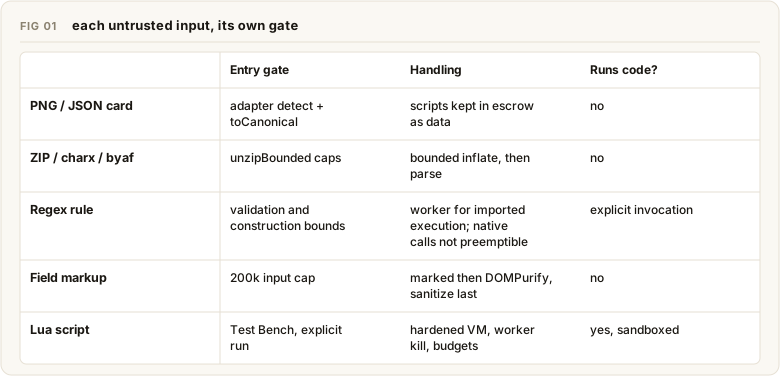
Untrusted inputs include character cards, archives, markup, Lua, regex rules, model responses, and
remote requests. Imported scripts remain data during import and conversion. Execution requires a
supported action and its corresponding gate. Enabling an imported regex set for a scene is an
explicit invocation; importing the set is not.
The primary Studio listener binds to loopback. Remote access is a separate, opt-in authority with
its own authentication and host-only controls. A provider-backed turn sends the conversation and
requested observations to the configured provider; local storage does not make that request local.
| Boundary | Authoritative reference | What is enforced |
|---|---|---|
| Import and conversion | Architecture, escrow and round trips | Canonical adapters preserve source data without executing imported payloads. Same-format semantic fidelity is distinct from byte identity. |
| Archives | Archive safety | Entry, size, and decompression checks. The reference distinguishes pre-allocation limits, post-inflate checks, and exported entry-name residuals. |
| Regex | Regex safety | Validation after find-side substitution, conservative AST refusal, construction/output limits, and isolated workers for imported execution. Native synchronous calls have no hard preemption guarantee. |
| Markup and previews | Safe rendering | Sanitization, URL/style restrictions, preview policy, and explicit browser/packaged-host verification limits. |
| Lua | Script sandbox | Restricted capabilities, value-only messages, memory/state limits, and a terminable worker. |
| Local API | Secrets and keys | Host and Origin checks, per-launch mutation bearer, foreign-page read refusal, and bounded request bodies. A local process can obtain the loopback shell's bearer. |
| Remote access | Remote-access threat model | Explicit enablement, join/device approval, host-only controls, bounded LAN authentication work, and verified helper downloads. |
| Provider credentials | Secrets and keys | Encrypted vault, backend-tagged decryption, atomic verified writes, and refusal of damaged reads before they become empty state. |
| Guarded HTTP provider requests | Secrets and keys | Configured-host checks on every redirect hop, scheme restrictions, and HTTPS downgrade refusal. External provider CLIs and connected subprocesses have separate network behavior. |
Evidence and remaining limits
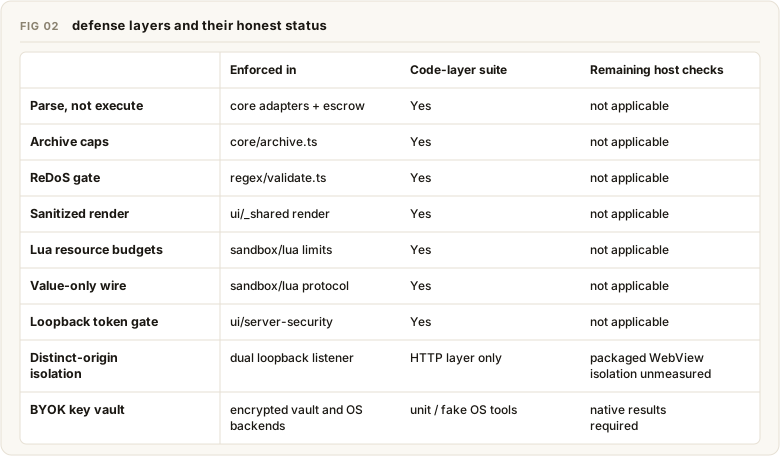
Code-level tests cover these boundaries. A passing source test is not proof of the packaged host,
real OS-keychain behavior, or every external provider. The reference for each boundary names the
corresponding tests and unverified cases.
- Packaged origin isolation remains unmeasured. The second loopback sandbox origin is tested at
the HTTP/handler layer. WebView2 storage visibility and credentialed API access from the packaged
sandbox have not been measured. A same-origin worker fallback is degraded, not isolated
(ADR-009). - Native regex matching is not interruptible. Static refusal and construction bounds reduce
risk. Checks around a native call cannot stop it mid-match. Imported regex execution uses its
isolated worker; the exact scope is documented in regex safety. - Local-key-file protection is weaker than OS key storage. A reader who obtains both that key
file and its vault can decrypt the vault. The passphrase backend has no settings-driven unlock
flow. These are explicit credential-storage limits. - Damaged credentials are preserved. Only a missing vault reads as empty. Other file, envelope,
and plaintext-shape failures reject reads and subsequent saves. The narrow damaged-identity-file
recovery preserves both original files and reports the incident. This does not establish
cross-process write-conflict safety or change the decrypted cache lifecycle. - Diagnostic isolation is separate from native proof. The keychain probe uses a fresh
probe-only service and cleans only its own entries. Isolated child-process regressions preserve
planted application credentials and cover failed cleanup; real macOS/Linux verification belongs
to recorded runs of the configured CI job.