Docs / Developer / Lorebook entity
Lorebook entity
A CanonicalLorebook is CanonicalEntity<"lorebook", LorebookBody>: the stable canonical wrapper
(see architecture.md) around a LorebookBody, the superset shape that unions
what every real world-info/lorebook format expresses. src/entities/lorebook/schema.ts is the source
of truth for the types; this page is the source of truth for what each field MEANS and which formats
produce it.
A lorebook is a set of entries, each a chunk of text that gets injected into the prompt when its
triggers match the recent conversation. Different apps call this world info, lorebook, character book,
or memory; the mechanics are the same. The canonical shape adopts RoleCall's in-memory entry type as its
baseline, a practical superset of SillyTavern World Info, Risu, Agnai, Chub, Lumiverse, and NovelAI's
portable surface, verified against real wire producers (see the escrow section at the end of this page
for what that verification ruled out).
How to read the field tables
The field tables on this page are generated from the schema by scripts/docs-fields.ts and embedded
verbatim. Do not hand-edit a cell: improve the schema doc comment and regenerate, and the docs follow.
- Field is the canonical name. A trailing
?marks an optional field. - Type is the TypeScript type in the schema.
- Producers are the source formats named in the field's schema doc comment. A
-means the doc
comment names no specific producer. Many such fields are the universal core every format carries
(content,enabled,triggers,position,depth); others simply have their provenance
described in prose rather than tagged inline. - Meaning is what the field is for. A blank Meaning cell is a self-evident primitive named by its
own field, and marks a field the schema doc comment did not annotate. Non-obvious fields carry their
meaning from the schema doc comment. Any richer explanation lives in the prose around a table, never
inside a cell.
Composition
LorebookBody is book-level settings (identity, categorization, matching defaults, budget) plus two
lists: entries: LorebookEntry[], the triggerable content, and an optional categories?: LorebookCategory[] for folder grouping. Unlike CharacterBody, the schema does not splitLorebookEntry's roughly 48 fields into named sub-interfaces: it is one flat interface, matching
RoleCall's own flat in-memory entry type. This page groups those fields by concern in the sections
below for readability; the schema itself, and the generated table, keep them flat.
Lorebook capability mutations that name entry ids fail with an error if any requested id is missing;
bulk requests with no ids remain empty no-ops. Callers can therefore distinguish a stale target from
an intentionally empty selection.
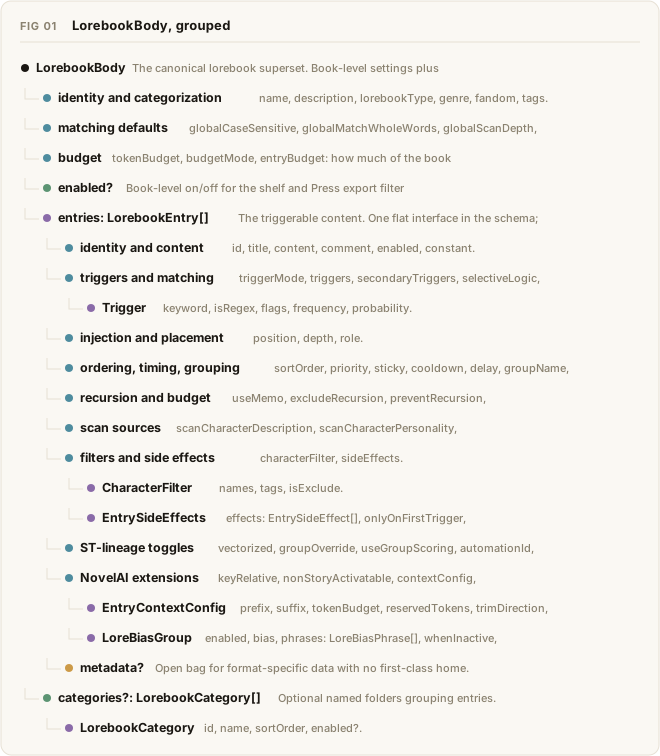
The sections below walk each group. Every field table on this page is pasted verbatim from
docs/generated/fields.lorebook.md.
Book settings
Identity, categorization, the matching defaults every entry inherits unless it overrides them, and the
injection budget for the whole book.
| Field | Type | Producers | Meaning |
|---|---|---|---|
name |
string |
- | |
description? |
string | null |
- | |
lorebookType? |
LorebookType | null |
- | |
genre? |
string | null |
- | |
fandom? |
string | null |
- | |
tags |
string[] |
- | |
enabled? |
boolean |
RC | Book-level on/off for the shelf + Press export filter. Default true when absent (older books). RC can round-trip it; other formats ignore (deny by absence). |
globalCaseSensitive |
boolean |
- | global matching defaults; entries with null matching options inherit these |
globalMatchWholeWords |
boolean |
- | |
globalScanDepth |
number |
- | |
globalRecursion |
boolean |
- | |
tokenBudget |
number |
- | |
budgetMode |
"token" | "entry" |
- | |
entryBudget |
number |
- | |
entries |
LorebookEntry[] |
- | |
categories? |
LorebookCategory[] |
- |
lorebookType is an open-ish role tag: "world" | "character" | "scenario" | "rules" | "utility" | "other". globalMatchWholeWords, globalScanDepth, and globalRecursion share the same intent asglobalCaseSensitive (book-wide matching defaults) even though only the first field's row carries the
schema doc comment; a blank Meaning cell here is the "self-evident primitive" convention from above,
not a different rule. budgetMode decides whether tokenBudget or entryBudget is the active cap.
LorebookCategory
A folder grouping entries within a lorebook. An entry joins one via categoryId.
| Field | Type | Producers | Meaning |
|---|---|---|---|
id |
string |
- | |
name |
string |
- | |
sortOrder |
number |
- | |
enabled? |
boolean |
- |
Entries
A LorebookEntry is one triggerable chunk: content, plus the conditions under which it fires and where
it lands in the assembled prompt. id is stable across round-trips; it is what categoryId and the
escrow twin-matching logic reference. The full generated table is below; the concern groups that follow
it are this page's own organization, not separate TypeScript shapes.
| Field | Type | Producers | Meaning |
|---|---|---|---|
id |
string |
- | stable entry id, preserved across round-trips (categories reference it) |
title |
string |
ST | entry label (maps to ST comment) |
content |
string |
- | |
comment? |
string | null |
RC, ST | internal creator note; distinct from title, has no ST home (RC-only) |
enabled |
boolean |
- | |
constant |
boolean |
- | always inject regardless of keyword match |
triggerMode |
"simple" | "advanced" |
- | |
triggers |
Trigger[] |
- | |
secondaryTriggers |
Trigger[] |
- | |
selectiveLogic |
SelectiveLogic |
- | |
caseSensitive |
boolean | null |
- | null = inherit the lorebook global |
matchWholeWords |
boolean | null |
- | |
scanDepth |
number | null |
- | |
position |
InjectionPosition |
- | |
depth |
number |
- | used when position is "depth" or "append" |
role |
MessageRole |
- | |
sortOrder |
number |
CCv3, RC, ST, Risu, Agnai | Placement / insertion order: where the entry lands relative to its siblings in the assembled prompt. The universal ordering axis - ST order, Risu insertorder, CCv3 insertion_order, Agnai weight, RC sortOrder. ST's displayIndex is separately canonicalized as the creator's authored list order; it is neither this axis nor derived from it. |
priority |
number |
CCv3, RC, ST, Risu, Agnai | Eviction / budget priority: which entries survive when the token budget is exceeded (higher survives). A separate axis from placement - CCv3 priority, Agnai priority, RC priority. Formats with no eviction field (ST, Risu) default this to 100. |
sticky |
number |
- | |
cooldown |
number |
- | |
delay |
number |
- | |
groupName |
string | null |
- | |
categoryId |
string | null |
- | references a LorebookCategory.id |
groupWeight |
number |
- | |
probability |
number |
- | entry-level activation chance 0-100 (fallback for simple triggers) |
useMemo |
boolean |
- | |
excludeRecursion |
boolean |
- | will NOT be found during recursion (direct matches only) |
preventRecursion |
boolean |
- | this entry's content will NOT trigger other entries |
delayUntilRecursion |
number |
- | only activate at recursion level N (0 = first pass) |
characterFilter |
CharacterFilter | null |
- | |
scanCharacterDescription |
boolean |
- | |
scanCharacterPersonality |
boolean |
- | |
scanUserPersona |
boolean |
- | |
scanScenario |
boolean |
- | |
scanCharacterDepthPrompt? |
boolean |
ST | extra ST worldinfo scan sources (undefined = not produced by this format / off) |
scanCreatorNotes? |
boolean |
- | |
ignoreBudget |
boolean |
- | bypass token budget - always inject |
vectorized? |
boolean |
ST | Authored ST-lineage entry toggles that only some formats carry (optional: undefined = the format has no such field, distinct from an explicit false a producer set). First-classed per the schema-is-editor doctrine, not original. vectorized is the RAG toggle (the SETTING, not the vectors, which stay original); groupOverride/useGroupScoring extend the groupName/groupWeight mutual-exclusion axis; automationId binds an entry to a Quick-Reply automation by id (the id only, the automation set stays original). |
groupOverride? |
boolean |
- | |
useGroupScoring? |
boolean |
- | |
automationId? |
string | null |
- | |
keyRelative? |
boolean |
NovelAI | NovelAI: keys match relative to the entry's own insertion point, not the story tail |
nonStoryActivatable? |
boolean |
NovelAI | NovelAI: entry can activate outside story text (e.g. from a UI action) |
contextConfig? |
EntryContextConfig |
NovelAI | NovelAI authored per-entry assembly config (prefix/suffix/trim/budget dials) |
loreBiasGroups? |
LoreBiasGroup[] |
NovelAI | NovelAI phrase bias groups (loreBiasGroups on wire) |
displayIndex? |
number | null |
ST | Creator's manual display order in the editor list - a DISTINCT authored axis from sortOrder (placement in the assembled prompt). The synthetic SillyTavern PNG fixture exercises distinct values (0-3 while sortOrder is uniform); this demonstrates codec preservation, not a real-corpus observation. It is NOT regenerable from sortOrder. null/undefined = follow sortOrder. |
sideEffects |
EntrySideEffects | null |
- | |
boostIds |
string[] (optional) |
- | ids of entries in the same book whose chance this entry raises when it fires |
boostAmount |
number (optional) |
- | 0 to 1, added to each boosted entry's chance (capped at 1) |
metadata? |
Record<string, unknown> |
- | extensible bag for format-specific data with no first-class home |
Identity and content
title is the display name (ST's comment field). comment is a separate internal authoring note
RoleCall carries; ST has no field for it distinct from the title, so it always canonicalizes to null
on an ST import. content is the injected text itself.
Triggers and matching
triggers and secondaryTriggers are keyword/regex lists that gate activation; selectiveLogic picks
how the secondary set combines with the primary (and_any, and_all, not_any, not_all).triggerMode is "advanced" when triggers carry their own per-trigger probability, overriding the
entry-level fallback, and "simple" otherwise. caseSensitive, matchWholeWords, and scanDepth are
per-entry overrides of the book's global defaults; null inherits.
Trigger
| Field | Type | Producers | Meaning |
|---|---|---|---|
keyword |
string |
- | |
isRegex |
boolean |
- | |
flags? |
string |
- | regex flags: g, i, m, s, u, y |
frequency? |
number |
- | min messages that must pass before this trigger can re-activate its entry |
probability? |
number |
- | advanced mode only: per-trigger activation chance 0-100, overrides the entry fallback |
A regex trigger is encoded on the wire as /pattern/flags; isRegex and flags carry that
structurally in canonical instead of a delimited string.
Injection and placement
position picks where the content lands in the assembled prompt: "world" / "character" are the
portable floor every format has (SillyTavern's before/after the character definition); the rest are
richer positions that degrade to the floor on downcast to a CCv2 character_book (see
concepts/character-book.md). depth applies when position is"depth" or "append". role is which chat role ("system" / "user" / "assistant") the injected
text speaks as.
Ordering, timing, and grouping
sortOrder and priority are two distinct axes: sortOrder is placement in the assembled prompt (the
universal ordering axis every format carries under some name), priority is eviction priority when the
token budget is exceeded (higher survives). A third, separate axis, displayIndex, is covered under
"ST-lineage toggles" below. sticky, cooldown, and delay are turn-counted timing; a delayed entry is held back during recursion as well, so a book's recursion cannot wake it before the scene has that many messages. groupName puts
entries into an inclusion group where only some of them fire, weighted by groupWeight; categoryId
links to a LorebookCategory instead, a purely organizational axis unrelated to activation. probability
is the entry-level activation chance, the fallback used by simple-mode triggers.
Recursion and budget
excludeRecursion keeps the entry from being found by another entry's recursive scan; preventRecursion
keeps the entry's own content from triggering others. delayUntilRecursion gates the entry to a specific
recursion pass. ignoreBudget always injects the entry regardless of the book's token budget. useMemo
marks the entry as a client-specific memo.
Scan sources
scanCharacterDescription, scanCharacterPersonality, scanUserPersona, and scanScenario extend
keyword matching to that extra text, beyond the chat itself. scanCharacterDepthPrompt andscanCreatorNotes do the same for two SillyTavern-only extra sources; undefined means the producing
format has no such field, not that scanning is off. scanCreatorNotes carries no producer tag of its
own in the generated table (its schema doc comment sits above scanCharacterDepthPrompt, covering both
together), but the SillyTavern codec (src/formats/sillytavern/lorebook.ts) confirms it round-tripsmatchCreatorNotes directly, same as its sibling.
Filters and side effects
characterFilter whitelists or blacklists the entry to specific characters or character tags.sideEffects is a list of variable mutations (set, append, increment, decrement, delete; local or global) that
run when the entry fires: the prompt assembler applies them to the scene's own variables before any macro
resolves, so {{getvar}} in the same prompt sees them. A new version of a reply starts from the variables as
they were before the reply it replaces ran them, so they are never counted twice. boostIds andboostAmount are Bunzai-authored cross-entry boosting: when the entry fires, each listed entry of the same
book that also matched is likelier to be injected.
CharacterFilter
| Field | Type | Producers | Meaning |
|---|---|---|---|
names |
string[] |
- | |
tags |
string[] |
- | |
isExclude |
boolean |
- |
EntrySideEffect
| Field | Type | Producers | Meaning |
|---|---|---|---|
type |
SideEffectType |
- | |
variable |
string |
- | |
value? |
string |
- | for setvar |
amount? |
number |
- | for addvar/incvar/decvar |
scope |
"local" | "global" |
- |
type is one of "setvar" | "addvar" | "incvar" | "decvar" | "delvar", declarative data only, never
executed by the converter or editor.
EntrySideEffects
| Field | Type | Producers | Meaning |
|---|---|---|---|
effects |
EntrySideEffect[] |
- | |
onlyOnFirstTrigger |
boolean |
- | |
clearOnDeactivate |
boolean |
- |
ST-lineage toggles
vectorized, groupOverride, useGroupScoring, automationId, and displayIndex are authored
SillyTavern-lineage fields, first-classed under the schema-is-editor doctrine even though only ST
currently serializes them (see the schema.ts doc comment: single-platform is not a reason to leave an
authored field in escrow). vectorized is the RAG toggle, the setting rather than the vectors
themselves, which stay in escrow. groupOverride / useGroupScoring extend the groupName /groupWeight mutual-exclusion axis. automationId binds the entry to a Quick-Reply automation by id
only; the automation itself stays in escrow. displayIndex is the creator's manual list order in the ST
editor, a distinct authored axis from sortOrder. The synthetic SillyTavern PNG fixture exercises a
uniform sortOrder with displayIndex values 0 through 3; this demonstrates codec preservation,
not a real-corpus observation. It is never regenerated from sortOrder.
NovelAI extensions
keyRelative and nonStoryActivatable are NovelAI-only trigger behavior toggles. contextConfig is
NovelAI's authored per-entry assembly config: prefix/suffix text, trim strategy, and a token budget local
to the entry. loreBiasGroups carries NovelAI's phrase-bias groups, a signed logit bias applied while
the entry is (or, with whenInactive, is not) active.
EntryContextConfig
| Field | Type | Producers | Meaning |
|---|---|---|---|
prefix? |
string |
- | text prepended to the entry when inserted |
suffix? |
string |
- | text appended to the entry when inserted |
tokenBudget? |
number |
- | per-entry token budget cap |
reservedTokens? |
number |
- | tokens reserved so the entry is not trimmed away |
trimDirection? |
string |
- | trim strategy: "doNotTrim" | "trimBottom" | "trimTop" (open: NAI may add values) |
insertionType? |
string |
- | join strategy: "newline" | "space" | "token" |
maximumTrimType? |
string |
- | trim granularity: "sentence" | "newline" | "token" |
insertionPosition? |
number |
- | signed offset within the target context section (NOT canonical depth - a different axis) |
NAI's budgetPriority is deliberately not modeled here: it is the placement axis and lives insortOrder, one home per axis, same as the sortOrder / priority split above.
LoreBiasPhrase
| Field | Type | Producers | Meaning |
|---|---|---|---|
sequence? |
string |
- | |
sequences? |
string[] |
- | |
type? |
number |
- | NAI phrase type (int on wire; open enum) |
LoreBiasGroup
| Field | Type | Producers | Meaning |
|---|---|---|---|
enabled |
boolean |
- | |
bias |
number |
- | signed strength (e.g. -0.5, 0.2) |
phrases |
LoreBiasPhrase[] |
- | |
whenInactive? |
boolean |
- | |
generateOnce? |
boolean |
- | |
ensureSequenceFinish? |
boolean |
- |
Metadata
metadata is an open bag for format-specific data with no first-class canonical home.
What rides escrow, not a field
Per the superset rule (see architecture.md), a field earns a canonical slot only
if some real wire format serializes it. Rides escrow, because no serializer emits it: three RoleCall
in-memory-only fields, allowRecursion, scanPreset, and probabilityMode, fail that gate (RoleCall'sboostIds and boostAmount fail it too, but the engine reads them and the World wing authors them, so they
have Bunzai-authored slots that RoleCall's export drops). The schema.ts doc comment records them as verified absent from packages/lorebook'sserializeEntryToRoleCallV1 and parser, and that its parser hardcodes them as defaults with its own
comment that the RC schema does not have them yet; packages/lorebook is an external VAUDEVILLE-platform
source, not in this repository, so that claim rides on the schema comment rather than an independent
read here. This repo's own src/formats/rolecall/lorebook.ts corroborates it as far as it can: none of
those field names appear anywhere in that codec.
Separately, format-specific wire bytes ride via the escrow raw-twin mechanism so a same-format
round-trip stays lossless, without becoming canonical fields themselves: SillyTavern's entry uid (used
to derive the canonical id on import, then re-emitted untouched from the raw twin on export) and
RoleCall's export envelope extras (tree, exportDate, per-entry unsupportedFields, trigger runtime
state) all round-trip this way.
Does NOT ride escrow, because it is modeled: SillyTavern's two extra scan sources
(matchCharacterDepthPrompt / matchCreatorNotes) are first-classed as scanCharacterDepthPrompt andscanCreatorNotes above, along with vectorized, groupOverride, useGroupScoring, automationId,
and displayIndex. These are authored ST wire fields a creator sets, not in-memory residue, so the
schema-is-editor doctrine puts them on the canonical entry even though only one format produces them
today.
See also
- architecture.md: the canonical model, escrow, hub-and-spoke, the adapter contract.
- entities/character.md: the character superset, linking here via
knowledgeRefs. - concepts/character-book.md: how an embedded
character_bookis extracted into a standalone lorebook on import and re-embedded on export. - formats/rolecall.md: the format the canonical entry shape is baselined on.
- formats/novelai.md: the source of the NovelAI-only extension fields (
contextConfig,loreBiasGroups,keyRelative,nonStoryActivatable). - formats/README.md: the coverage matrix of every format and the fields it produces.