Docs / Developer / Agnai format
Agnai format
Agnai (Agnaistic) is a browser/self-hosted AI roleplay app with its own native JSON character shape. It
is not Tavern-lineage: instead of a flat description block, its persona is structured, a kind plus an
attribute map, which is exactly what the canonical persona.structured
field exists to preserve. Every adapter here reads and writes .json.
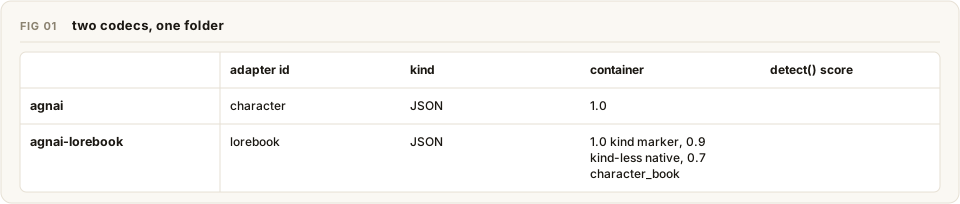
The format is one folder, src/formats/agnai/, whose index.ts default-exports two codecs
(index.ts:363):
agnai, kindcharacter, reads and writes JSON.agnai-lorebook, kindlorebook, reads and writes JSON. This is Agnai's standalone memory book; the
same MemoryBook shape also comes embedded inside a character ascharacterBook, see
Escrow and round-trip.
This page documents both codecs in full. The Agnai schema was read from Agnai's own source
(common/types/library.ts, common/adapters.ts, common/types/memory.ts, common/memory.ts,common/types/texttospeech-schema.ts, common/types/sprite.ts, common/types/image-schema.ts;
AGPL-3.0) as interop facts only, no Agnai code is copied (index.ts:1-7, samples/agnai/SOURCES.md).
For the canonical field meanings this format maps onto, see
entities/character.md and entities/lorebook.md. For
the hub-and-spoke, escrow, and detection model, see architecture.md. For the whole
matrix of formats, see FORMAT-SUPPORT.md.
Detection
The registry runs every adapter's detect() and keeps the single highest score above 0.5, so more
specific formats outrank generic ones (architecture.md, "Detection and the registry").
Character
detect() parses the input as JSON and returns 1.0 only when all five hold, 0 otherwise
(index.ts:312-329):
kind === "character",personais a non-null object,greetingis a string,schemaVersionisundefined,bodyisundefined.
The last two clauses are the firewall against bunzai's own native wrapper: a vaud-json entity carriesschemaVersion and body, so requiring both absent stops Agnai from fighting vaud-json on the same
file (index.ts:317-324). A parse failure or missing text returns 0 (index.ts:313-314,326-327).
Agnai scores 1.0, not 0.9, because it is a specific, self-identifying shape: no other adapter claims
a superset of it the way RoleCall claims a superset of a SillyTavern card.
Lorebook
agnai-lorebook reads the input as a memory book via coerceMemoryBook and scores (lorebook.ts:305-313):
1.0when the unambiguouskind: "memory"marker is present (lorebook.ts:285,309).0.9for a kind-less book whoseentriesis an array and whose first entry still carries the nativeentry+keywordsshape (lorebook.ts:286-290,309). This is what distinguishes a native Agnai book
from a bare CCv3character_book, whose entries usecontent/keysinstead.0.7for a standalone CCv3/Chub-stylecharacter_book(isStandaloneCharacterBook, entries carrykeysand/orcontent), re-exported as a real MemoryBook (lorebook.ts:310-311,_shared/character-book.ts:270-284).0otherwise, including a SillyTavern worldbook (entriesis a keyed object, not an array) and a Risu
native envelope (no top-levelentriesarray).
Field map
Decode (toCanonical) via cardToBody / bookToCanonical, encode (fromCanonical) viaapplyBodyToCard / canonicalToMemoryBook. Only string values survive character decode (a tolerantstr()/strList() returns undefined for the wrong type); only defined values are written back on
encode.
Character
| Source field | Canonical path | Notes |
|---|---|---|
name |
identity.name |
Defaults to "" when absent. index.ts:178 |
description |
identity.description |
index.ts:179 |
characterVersion |
identity.characterVersion |
index.ts:180 |
culture |
identity.culture |
Agnai-only; drives default language/voice selection. index.ts:181 |
persona |
persona.personality + persona.structured |
See the persona notes below the table. index.ts:175,183-187 |
scenario |
persona.scenario |
index.ts:185 |
appearance |
persona.appearance |
Agnai-only free-text physical description, kept out of description so it can drive image generation. index.ts:186 |
voice + voiceDisabled |
persona.voice |
Discriminated on service -> Voice.provider; voiceId/rate/pitch are first-classed, everything else rides Voice.extras. index.ts:70-80,188 |
imageSettings.{prefix,suffix,negative,template} |
persona.imagePrompt |
The authored affixes only; sampler/provider knobs stay on the escrow twin. index.ts:118-126,189 |
systemPrompt |
prompts.systemPrompt |
index.ts:192 |
postHistoryInstructions |
prompts.postHistoryInstructions |
index.ts:193 |
prefill |
prompts.prefill |
Agnai's assistant-response prefill, prepended to the model reply, common with Claude. index.ts:194 |
insert |
prompts.depthInjections[0] |
{ depth, prompt }. Agnai's one fixed-depth slot; a canonical entity with multiple depth injections keeps only the first on export. index.ts:195,238-240 |
greeting |
greetings.firstMessage |
index.ts:198 |
alternateGreetings |
greetings.alternateGreetings[].text |
Bare strings wrapped as { text }; on encode only .text is written, so a greeting title from another format is dropped. index.ts:199,231 |
sampleChat |
examples.exampleMessages |
index.ts:201 |
avatar |
media.portrait |
Face image (data URI or URL, not the sprite recipe). Mime is guessed from the data URI or file extension, undefined when unknown. index.ts:128-151,203 |
sprite |
media.sprite |
Agnai's FullSprite is flat (part keys plus eyeColor/bodyColor/hairColor/gender at one level); it decodes to { parts, ...specials }. index.ts:92-107,204 |
visualType |
media.visualKind |
Which visual mode the creator chose, "avatar" or "sprite". index.ts:205 |
creator |
attribution.creator |
index.ts:207 |
tags |
discovery.tags |
index.ts:208 |
json |
settings.responseSchema |
Agnai's structured-output ResponseSchema, carried verbatim-editable. index.ts:209 |
| whole card | original.agnai.raw |
The parsed source card is retained as a twin; export clones it and overlays canonical fields. JSON is regenerated, so this is field fidelity rather than byte-identical output. index.ts:342,353-359 |
Agnai's persona is { kind, attributes }, where kind is one of boostyle | wpp | sbf | attributes | text and attributes is Record<string, string[]> (index.ts:29,31-34). It decodes via toStructured
(index.ts:159-165):
Agnai persona.kind |
Canonical result |
|---|---|
"text" |
structured = { kind: "text" }; persona.personality = attributes.text[0] |
boostyle / wpp / sbf / attributes |
structured = { kind, attributes: attributes ?? {} }; personality stays unset |
A plain-text persona lands in the human-readable personality field, with structured recording that it
was text; a W++/square-bracket/boostyle attribute map is preserved intact in structured.attributes. The
union is designed so illegal states are unrepresentable: { kind: "text" } carries no attributes, and
every attribute-map kind requires its attributes.
Encode via toAgnaiPersona goes the other way (index.ts:168-172): if structured is present and itskind is not "text", it emits { kind, attributes } verbatim; otherwise it emits a text persona,{ kind: "text", attributes: { text: [personality ?? ""] } }. applyBodyToCard calls this
unconditionally, so persona is always rebuilt from canonical rather than overlaid onto the twin
(index.ts:241); see Escrow and round-trip for the one place that costs.
Lorebook
Agnai's MemoryEntry uses field names that differ from CCv3: the content is entry (not content), the
keywords are a plain array keywords (not a CSV string), and the two ordering axes are both explicit,weight for placement and priority for eviction (lorebook.ts:1-22,41-59).
| Source field | Canonical path | Notes |
|---|---|---|
name |
title |
Falls back to Entry N when absent. lorebook.ts:101 |
entry |
content |
lorebook.ts:102 |
comment |
comment |
Agnai's own distinct note field, separate from name (unlike ST/Risu, where title and comment coincide). lorebook.ts:103 |
enabled |
enabled |
Defaults true. lorebook.ts:105 |
constant |
constant |
lorebook.ts:106 |
keywords |
triggers |
Plain strings, always isRegex: false; Agnai has no regex-key feature. lorebook.ts:81-82,109 |
secondaryKeys |
secondaryTriggers |
Plain strings. lorebook.ts:97,110 |
selectiveLogic |
selectiveLogic |
ST-import residue on the ST numeric convention (shared lore-enums decoder); absent defaults to and_any. lorebook.ts:112, _shared/lore-enums.ts:16-17 |
position |
position |
before_char maps to world, after_char maps to character, the ST-parity floor. lorebook.ts:85,118 |
weight |
sortOrder |
The placement axis. lorebook.ts:122 |
priority |
priority |
The eviction axis. lorebook.ts:123 |
probability + useProbability |
probability |
useProbability !== false gates it; clamped 0..100, defaults to 100. lorebook.ts:92-96 |
excludeRecursion |
excludeRecursion |
lorebook.ts:136 |
scanDepth |
globalScanDepth |
Book-level. lorebook.ts:164 |
tokenBudget |
tokenBudget |
Book-level. lorebook.ts:166 |
recursiveScanning |
globalRecursion |
Book-level. lorebook.ts:165 |
lorebookType is a hardcoded "other" on import, since Agnai memory books are general library entities,
not character-scoped by default (lorebook.ts:158). caseSensitive, matchWholeWords, and scanDepth
are per-entry null (Agnai has no per-entry flags for them; scan depth is book-level) (lorebook.ts:114-116).
The weight/priority split is grounded in Agnai's own round-trip code: the codec's header comment
records that Agnai's memoryEntryToNative (common/memory.ts, not in this repo, cited as an interop
fact) maps CCv3 insertion_order to weight and CCv3 priority to priority, so weight tosortOrder and priority to priority matches Agnai's own convention (lorebook.ts:11-15). That local
mapping (weight to sortOrder, priority to priority) is verified in this repo; the claim about
Agnai's own memoryEntryToNative is asserted by the comment, not independently checkable here.
Escrow and round-trip
The escrow envelope is the canonical wrapper's original field, a Record<FormatId, OriginalEntry> keyed
by format id (canonical.ts:39-51,80). The architecture calls this concept escrow; the wrapper field is
named original. The character adapter stores its twin at original.agnai, the lorebook codec at its own
key, original["agnai-lorebook"].
original.agnai = { raw: <the entire parsed card> }
On export, fromCanonical deep-clones that raw card, or builds a minimal baseCard() when there is no
twin, for example a cross-format import, and overlays the canonical body onto it with applyBodyToCard,
then serializes with JSON.stringify(card, null, 2) (index.ts:353-359,280-289). Any raw key with no
canonical slot, extensions, _id, userId, survives in the cloned parsed value.
The character overlay does not diff against the decoded twin the way the lorebook and SillyTavern
codecs do: set() unconditionally writes the current canonical value whenever it is defined, and deletes
a key only when canonical is undefined and the twin held a string or array (index.ts:213-224). For a
well-formed twin this produces the same output as a diff would; a malformed non-string value the importer
skipped is left untouched rather than stripped, because the delete branch only fires on a string or array
(index.ts:221-224).
persona is the exception: applyBodyToCard always rebuilds it from the canonical body viatoAgnaiPersona, never preserving the cloned raw persona (index.ts:241). For attribute-map kinds this
is exact. For a text persona whose attributes.text had more than one element, decode keeps onlyattributes.text[0] as personality (index.ts:162), and encode re-emits { text: [personality] }
(index.ts:171). A multi-element text array therefore collapses to its first element even on an Agnai to
Agnai round-trip; single-element text personas and all attribute-map personas are faithful.
The lorebook entry overlay, entryToWire, is a real three-state diff: with a twin present it clones the
twin and rewrites only the fields whose canonical value changed from the twin's own decode, so an
untouched entry retains its parsed fields, including Agnai-only residue such as selectiveLogic; JSON
serialization can normalize whitespace, so this is not a byte-for-byte file guarantee
(lorebook.ts:184-236). Entries are matched to their twin by id (canonicalToMemoryBook, a Map
keyed by id, lorebook.ts:238-247). Optional book fields, scanDepth, tokenBudget,recursiveScanning, preserve the twin's presence or absence rather than always emitting a default
(lorebook.ts:248-256), and _id/userId are never reintroduced. With no twin, canonicalToMemoryBook
starts from a clean { kind: "memory" } object instead of a clone, so the book is written from the
canonical body alone (lorebook.ts:243).
Repeated raw entry ids receive stable unique canonical ids (7, 7-2, ...), and export indexes each
source row by that same assignment. Reordered duplicate-id entries therefore keep their own unknown
fields attached to the correct raw twin (lorebook.test.ts).
Agnai's native character export also carries the character's lore inline as characterBook, a
MemoryBook, not a CCv3 character_book (index.ts:1-7,55-56). The character adapter implements the
optional extractLorebook hook (src/core/adapter.ts:75), readingcard.characterBook through the same memoryBookToCanonical the standalone agnai-lorebook codec uses
(index.ts:346-351, lorebook.ts:267-276), so a given MemoryBook canonicalizes identically whether it
arrives standalone or embedded, container-invariance by construction. fromCanonical re-embeds any linked
lorebook via applyLorebook / canonicalToMemoryBook, twin-overlaying its own original["agnai-lorebook"]
so a same-format round-trip with a book preserves its fields and raw-only residue; JSON serialization may
normalize whitespace. A foreign lorebook with no Agnai twin full-encodes into a clean MemoryBook
(index.ts:291-303). No book present means no characterBook key is
written, never an empty one. An explicitly resolved empty bundle also deletes a stale characterBook
from the cloned card twin (index.ts:298-304). The bundle layer's readPieces calls this override
instead of the shared CCv3 extractor used by Tavern-lineage formats (convert.ts).
Quirks
- Two-state character overlay, three-state lorebook overlay.
applyBodyToCard'sset()helper always
writes the current canonical value and deletes only on a cleared string/array; it does not compare
against the decoded twin.entryToWireon the lorebook side does compare, and only rewrites a changed
field. Same observable result on well-formed input, different mechanism.index.ts:213-224,lorebook.ts:184-236. - Persona is always rebuilt, never twin-preserved. A multi-element text persona (
attributes.textwith
more than one string) collapses to its first element on any round-trip, including Agnai to Agnai,
becausetoStructuredonly readsattributes.text[0]andtoAgnaiPersonaonly writes one.index.ts:162,171,241. - Detection's firewall is the absence of
schemaVersion/body, not their presence. This is what keeps avaud-jsonentity from being misread as an Agnai card on the same file.index.ts:317-324. imageSettingsaffixes reconcile per key, not as a whole block.prefix/suffix/negative/template
are canonical's to write or clear; every other key on the twin'simageSettings, sampler steps, cfg,
provider objects, survives an edit untouched because the merge starts from a clone of the twin.index.ts:261-274.insertis a single fixed-depth slot. OnlydepthInjections[0]re-encodes; the Agnai wire carries no
role, origin, or enabled flag for it, so thoseDepthInjectionfields stayundefinedon decode.index.ts:195,238-240.- The embedded
characterBookis Agnai-native, not a CCv3character_book. It is read and written by the
character adapter's ownextractLorebook/applyLorebook, using the same MemoryBook mapper as the
standaloneagnai-lorebookcodec, not the shared_shared/character-book.tsmapper that Tavern-lineage
formats use for their embedded books.index.ts:55-56,291-303,346-351. selectiveLogicis ST-import residue, not an Agnai-authored field. It appears only on entries an Agnai
user imported from SillyTavern and uses the shared ST numeric convention (0and_any ...3and_all);
a fresh cross-format encode never emits it, since Agnai's own editor never authors it.lorebook.ts:112,221-225,_shared/lore-enums.ts:16-20.
Source of truth
| Concern | File |
|---|---|
| Character adapter (detect, toCanonical, fromCanonical, extractLorebook) | src/formats/agnai/index.ts |
| Memory book (lorebook) adapter + shared mappers | src/formats/agnai/lorebook.ts |
| Coverage declaration | src/formats/agnai/coverage.ts |
Shared CCv3/Chub character_book mapper (the agnai-lorebook soft-import path) |
src/formats/_shared/character-book.ts |
Shared ST-numeric selectiveLogic decoder |
src/formats/_shared/lore-enums.ts |
| Bundle extract/re-embed wiring | src/convert.ts (readPieces, emitBundle), src/core/adapter.ts (extractLorebook, EmitContext) |
| Canonical character schema | src/entities/character/schema.ts |
| Canonical lorebook schema | src/entities/lorebook/schema.ts |
Canonical wrapper, escrow (original), id policy |
src/core/canonical.ts |
| Samples | samples/agnai/ (native character export + SOURCES.md) |
| Fixtures | samples/lorebooks/agnai/ |
| Interop reference (facts only, no code copied) | Agnai common/types/library.ts, common/adapters.ts, common/types/memory.ts, common/memory.ts, web/pages/Memory (encodeBook), common/types/texttospeech-schema.ts, common/types/sprite.ts, common/types/image-schema.ts (AGPL-3.0) |