Docs / Developer / SillyTavern format
SillyTavern format
SillyTavern is the de-facto standard ecosystem for local AI roleplay. bunzai reads and writes its Character
Card V1, V2, and V3 cards and its standalone world info (worldbook) files. The card is carried either as a.json file or embedded in a .png via base64 text chunks. The character codec writes .json by
default and .png when an export asks for one. V3 PNGs carry the full V3 JSON in ccv3 and a
V2-shaped backfill in chara; the other codecs here - worldbook, regex, persona, quick reply, preset, prompt format - write .json.
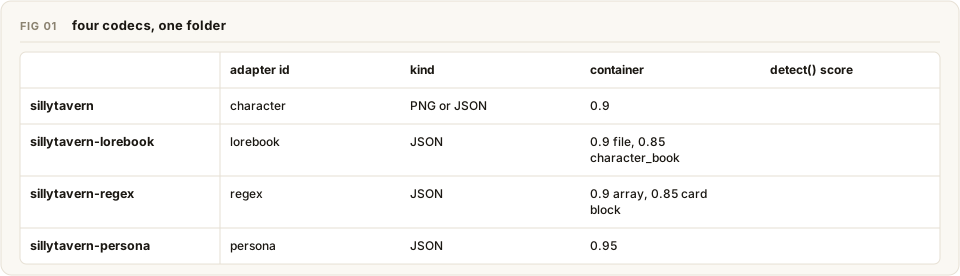
The format is one folder, src/formats/sillytavern/, whose index.ts default-exports these codecs
(index.ts:225):
sillytavern, kindcharacter, reads PNG or JSON.sillytavern-lorebook, kindlorebook, reads JSON.sillytavern-regex, kindregex, reads a bareRegexScriptData[]array or a card'sextensions.regex_scripts.sillytavern-persona, kindpersona, reads an ST personas backup file.sillytavern-quickreply, kindquickreply, reads an ST Quick Reply set.sillytavern-preset, kindpreset, reads completion presets, sampler sets, system prompts and reasoning templates.sillytavern-promptformat, kindpromptformat, reads instruct and context templates.
Another reader, chat.ts, is deliberately kept outside that array of seven codecs: it reads a chat .jsonl into a scene, which
is not a library piece, so it has no fromCanonical and joins no registry (the way .lvbak does not).inspectBytes calls it for any .jsonl. See Chats.
This page documents the character and lorebook codecs in full; the regex and persona codecs are covered
in summary under Quirks. For the canonical field meanings this format maps onto, see
entities/character.md and entities/lorebook.md. For
the hub-and-spoke, escrow, and detection model, see architecture.md. For the whole
matrix of formats, see FORMAT-SUPPORT.md.
Detection
The registry runs every adapter's detect() and keeps the single highest score above 0.5, so more
specific formats outrank generic ones (architecture.md, "Detection and the registry").
Character
detect() returns 0.9 for a recognizable card and 0 otherwise (index.ts:87-92). It is 0.9, not1.0, because SillyTavern is the generic Tavern reader: a more specific adapter that shares the same wire
shape (RoleCall, which claims 1.0 on a CCv3 card carrying an extensions.rolecall block) wins detection
and gets to map its own extension layer. On a plain CCv3 card with no such block, sillytavern is the
top score and reads it.
Two recognition paths (index.ts:88-91):
- PNG: if the input bytes are a PNG carrying a
chara(V2) orccv3(V3) text chunk, score0.9
(getVersion,png.ts:68-81). This does not stop at the bytes branch: a real.jsonread carries both
bytes and text, so a non-card PNG falls through to the JSON path (index.ts:90,card-io.ts:9-21). - JSON:
detectCardrecognizesspec: "chara_card_v3"with adataobject (V3),spec: "chara_card_v2"withdata(V2), or a flat object with nospec/datathat has anamestring plus a
real character signal (V1/flat) (index.ts:44-75).
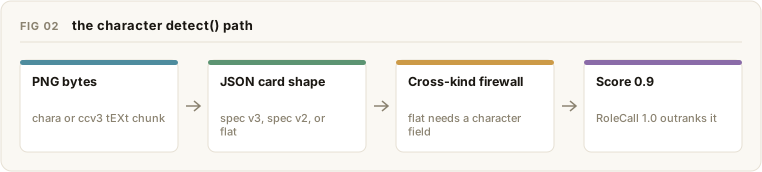
The flat/v1 branch is the cross-kind firewall. A SillyTavern worldbook is also { name, ... } JSON, so
without a tightening rule it would false-positive as a V1 character and collide with the lorebook codec
(architecture.md, "The cross-kind firewall"). The branch therefore fires only when the object carries aname and at least one character field (index.ts:54-72):
- A V1 core field:
description,personality,scenario,first_mes, ormes_example(index.ts:65-70). - A V2-era field:
alternate_greetings,system_prompt,post_history_instructions,creator_notes,extensions, orcharacter_version(index.ts:55-61).
If a V2-era field is present the variant is recorded as flat, otherwise v1 (index.ts:72). A worldbook
carries none of these, so it never reaches a positive here.
Lorebook
sillytavern-lorebook returns 0.9 for a native worldbook, 0.85 for a portable character_book, and0 otherwise (lorebook.ts:309-313):
0.9: a top-levelentriesobject keyed by string index (not an array, which would be RoleCall or
Agnai) whose first value looks like an entry (key/keysecondary/comment/content)
(lorebook.ts:43-53).0.85: a Chub-style or card-extractedcharacter_book(an object with anentriesarray)
(lorebook.ts:297-300,character-book.ts:270-284). It is portable as ST but scores below the native
file so the native shape wins any tie.
Field map
Character
The shared Tavern data mapping lives in src/formats/_shared/tavern-fields.ts (dataToBody on import,applyBodyToData on export), because SillyTavern and Risu carry the identical CCv2/V3 data shape. See
entities/character.md for what each canonical slot means.
| Source field | Canonical path | Notes |
|---|---|---|
data.name |
identity.name |
Required; defaults to "" when absent. tavern-fields.ts:114 |
data.nickname |
identity.nickname |
CCv3. tavern-fields.ts:115 |
data.description |
identity.description |
tavern-fields.ts:116 |
data.character_version |
identity.characterVersion |
tavern-fields.ts:117 |
data.personality |
persona.personality |
tavern-fields.ts:119 |
data.scenario |
persona.scenario |
tavern-fields.ts:119 |
data.first_mes |
greetings.firstMessage |
tavern-fields.ts:126 |
data.alternate_greetings |
greetings.alternateGreetings[].text |
Bare strings wrapped as { text }; ST never sets a title. tavern-fields.ts:56,127 |
data.group_only_greetings |
greetings.groupOnlyGreetings[].text |
V3 field; a V3 PNG's V2-shaped chara backfill carries it under extensions.vaudeville.escrow.fields. tavern-fields.ts:128, index.ts |
data.mes_example |
examples.exampleMessages |
tavern-fields.ts:130 |
data.system_prompt |
prompts.systemPrompt |
tavern-fields.ts:121 |
data.post_history_instructions |
prompts.postHistoryInstructions |
tavern-fields.ts:122 |
data.extensions.depth_prompt |
prompts.depthInjections[] (origin depth_prompt) |
{ prompt, depth, role }; empty prompt maps to no injection. tavern-fields.ts:77-87,123 |
data.creator |
attribution.creator |
tavern-fields.ts:133 |
data.creator_notes |
attribution.creatorNotes |
tavern-fields.ts:134 |
data.source |
attribution.source |
string[]; CCv3. tavern-fields.ts:135 |
data.creator_notes_multilingual |
attribution.creatorNotesMultilingual |
V3 field; escrowed in a V3 PNG's V2-shaped chara backfill. tavern-fields.ts:136, index.ts |
data.creation_date |
attribution.createdAt |
Number. tavern-fields.ts:137 |
data.modification_date |
attribution.updatedAt |
Number. tavern-fields.ts:138 |
data.tags |
discovery.tags |
tavern-fields.ts:140 |
data.extensions.talkativeness |
settings.talkativeness |
Tolerant read: string "0.5" or number to number. tavern-fields.ts:60-67,141 |
data.extensions.world |
worldName |
Name of a linked worldbook, not an embedded book. tavern-fields.ts:111,142 |
data.assets |
body.media (portrait + assets[]) |
CCv3 asset array to canonical media; bytes stay in escrow. index.ts:99, assets.ts:113-131 |
data.character_book |
knowledgeRefs |
Handled by the bundle layer, not tavern-fields; see below. index.ts:128, character-book.ts:291-319 |
| PNG carrier pixels | original.sillytavern.sourceMedia |
The PNG file is kept as a raw-bytes twin (authored art). png.ts:39-42, index.ts:107 |
depth_prompt, talkativeness, and world are authored fields ST keeps in extensions only because
CCv2/V3 is rigid. They are first-classed as editable canonical slots, not escrow. An empty depth_prompt.prompt
is ST's default-when-unset and maps to no injection, so the depth/role config rides the twin untouched;role is carried only when the card authored one, and its absence means ST's default (system) applied
at read time, never fabricated back on export (tavern-fields.ts:77-87).
data.character_book is not mapped by tavern-fields. An embedded book is a bundle concern: on import a
shared layer extracts it into a standalone CanonicalLorebook and links it from the character viaknowledgeRefs, and on export the adapter re-embeds referenced books into the single data.character_book
slot via the EmitContext it receives. A resolved empty list removes both the primary slot and the
legacy data.extensions.character_book fallback, so clearing or disabling a link cannot resurrect the
source twin's old book (index.ts:128-142, character-book.ts:462-478, architecture.md, "Bundles").
Lorebook
ST world info encodes several canonical enums as integers. The shared decoders live insrc/formats/_shared/lore-enums.ts.
| Canonical enum | ST integer coding | Source |
|---|---|---|
selectiveLogic |
0 and_any, 1 not_all, 2 not_any, 3 and_all |
lore-enums.ts:15-20 |
role |
0 system, 1 user, 2 assistant |
lore-enums.ts:22-25 |
position |
0 world, 1 character, 2 before_example, 3 after_example, 4 depth |
lorebook.ts:57-71 |
Entry field highlights (lorebook.ts:124-193); see entities/lorebook.md for the
full canonical entry.
| Canonical | ST wire | Notes |
|---|---|---|
title |
comment |
Falls back to Entry N when blank. lorebook.ts:133 |
content |
content |
lorebook.ts:134 |
enabled |
!disable |
ST canonicalizes on a disable flag. lorebook.ts:125,201 |
triggers |
key |
Inline regex /pattern/flags decodes to a structured trigger. lorebook.ts:94-107,140 |
secondaryTriggers |
keysecondary |
lorebook.ts:141 |
sortOrder |
order |
ST's placement (insertion) order. lorebook.ts:154 |
priority |
(none) | ST has no eviction axis, so priority defaults to 100. lorebook.ts:155 |
groupName |
group |
Empty string maps to null. lorebook.ts:161 |
scanCharacterDescription etc. |
matchCharacterDescription etc. |
lorebook.ts:174-177 |
scanCharacterDepthPrompt, scanCreatorNotes |
matchCharacterDepthPrompt, matchCreatorNotes |
Extra scan sources, present-or-absent. lorebook.ts:178-179 |
vectorized |
vectorized |
The RAG toggle, not the vectors. lorebook.ts:185 |
groupOverride, useGroupScoring |
group_override, use_group_scoring |
lorebook.ts:186-187 |
automationId |
automationId |
QR-automation binding id. lorebook.ts:188 |
displayIndex |
displayIndex |
Distinct authored display-order axis, not order. lorebook.ts:189 |
The embedded character_book uses a different wire dialect than the standalone worldbook file: CCv3 spec
field names at the entry top level (keys, secondary_keys, insertion_order, use_regex, coarsebefore_char/after_char position) with the ST-extended fields tucked into each entry's extensions
bag, read from both places with extensions winning (character-book.ts:1-15,153-235).
Chats
A SillyTavern chat file (chats/<card>/<name>.jsonl) imports as a scene through the same import route as a
card: POST /api/inspect reads it, save-bundle (or save-staged past 8 MiB) saves it into the ChatStore, and
the Library drop sheet lists it as a row (.jsonl is a triage candidate). The codec
(src/formats/sillytavern/chat.ts, dates in chat-dates.ts) returns a scene carrier of names, not a library
entity; src/studio/scene-import.ts resolves the character and persona by name against the library when it
saves, then calls createChat with the history (ChatStore rule 29). Refusals and open
questions are recorded in src/studio/scene-import.ts.
mesis the current swipe's text;swipesandswipe_idbecome the message's swipes and current one; each
swipe keeps its ownsend_date, model, reasoning and generation time (swipe_info).send_datereads in ST's humanized local-clock form, ISO, or epoch milliseconds.- A card that is not in the library refuses that file with the card's name and writes nothing; no placeholder
character is made. Two cards of one name, or replies under two library characters, refuse too. - A persona is stamped on a user line only when exactly one library persona has that name.
- A user line is matched to its persona by the avatar file it was written with (
force_avatar), the id the
persona codec imported it under (personaAvatarStem), so personas that share a name stay apart. - Lines hidden from the prompt in ST (
is_system) import with the hidden flag and the receipt counts them;chat_metadata.variablesbecome the take's variables; the author's note, timed world info and scenario are
named on the receipt as not carried. - A group chat is refused whole (a scene holds one character).
Escrow and round-trip
The escrow envelope is the canonical wrapper's original field, a Record<FormatId, OriginalEntry> keyed
by format id (canonical.ts:39-51,80). The architecture calls this concept "escrow"; the wrapper field is
named original. Each ST codec stores its twin under its own adapter id, so the character card twin lives
at original.sillytavern.
On import the character adapter stores the whole parsed card, plus the round-trip variant and
the PNG carrier (index.ts:105-108):
original.sillytavern = {
  raw:         <the entire parsed card, JSON or the decoded chunk>,
  unmapped:    { variant: "v2" | "v3" | "v1" | "flat" },
  sourceMedia: { b64, mime: "image/png" }   // only for PNG input
}
A same-format round-trip preserves canonical meaning and raw-only fields (architecture.md, "Escrow"). On export, fromCanonical
overlays the canonical body onto a clone of the raw card and preserves the original variant wrapper: a V3
card stays V3, a V2 card stays V2, a flat card stays flat (index.ts:112-148). The overlay is three-state
against the twin's decode (applyBodyToData, tavern-fields.ts:157-298): a canonical value equal to the
twin leaves its parsed wire value untouched, a changed value is written, and a value the twin had but canonical no
longer carries is cleared at its exact wire home. Unknown keys and non-representable raw (for example
RoleCall's object-form source) are left alone.
What crosses a cross-format conversion is only the canonical body. Everything else, the raw card, itsextensions block, unknown keys, and the PNG carrier, stays in escrow and is deliberately not copied into
another app's file (architecture.md, "Escrow: lossless round-trips, contained cross-format loss"). The
PNG carrier is served as the entity's portrait and is available to the PNG export path. That path
rewrites the card text chunks around the image; it does not promise byte-identical PNG output.
The lorebook codec follows the same rule. ST has fewer injection slots than canonical, so richer positions
collapse on export: append/append_bottom to depth (4), prepend_top to 0, scene to
before_example (2) (lorebook.ts:74-91). ST also has no per-trigger probability, so triggerMode is
always simple on read (lorebook.ts:139). That loss is inherent to ST and is what escrow-of-raw guards:
an unedited entry re-projects from its raw twin by id, preserving its fields and raw-only carriers; edited
fields are re-encoded and take the collapse (lorebook.ts:268-294). JSON serialization can normalize
whitespace; byte identity applies only where a fixture proves a format-specific byte tier. Raw-only
carriers with no authored meaning (entry uid, embedding vectors, loreCache) ride escrow untouched.
Duplicate uid values get stable unique canonical ids, and export uses those ids to keep each raw row's
unknown fields attached when entries are reordered (lorebook.test.ts).
Quirks
CCv2 vs V3. The V3-only fields (
assets,nickname,creator_notes_multilingual,source,group_only_greetings,creation_date,modification_date) stay in the full V3 envelope. A V3 PNG's
V2-shapedcharabackfill moves these fields underextensions.vaudeville.escrow.fields;ccv3
retains the full V3 serialization. A standalone V2 JSON card has no CCv3-only field slots. If canonical
media is present and the twin is not already V3, export upgrades the card to a V3 envelope because V2
has no portableassets[]contract (index.ts).PNG chunk embedding. A card lives in a base64
chara(V2) orccv3(V3)tEXtchunk. A V3 card is
normally written with both chunks:ccv3for the full card andcharafor a V2-shaped backfill for older
readers. V3-only values in that backfill ride underextensions.vaudeville.escrow.fields. Chunk order is
not specified, so the reader prefersccv3wherever present rather than the first
chunk, which would silently downgrade the card to its subset (png.ts:44-81).embedCharacterJson
writes thecharakeyword by default (png.ts:84).Flat/v1 needs a real character signal. A bare
{ name }object is not a character. The flat/v1 path
requiresnameplus a V1 or V2-era character field, which is the cross-kind firewall that keeps a
worldbook from importing as a character (index.ts:54-72). See Detection.Talkativeness is a tolerant number. Some cards store
extensions.talkativenessas a string ("0.5"),
others as a number; both read to a number (tavern-fields.ts:60-67). On write it is emitted as a number,
and an unchanged string twin is left as-is by the three-state overlay (tavern-fields.ts:270-276).World link is by name.
extensions.worldis the name of a separate worldbook, not an embedded book, so
it maps to the scalarworldName, notknowledgeRefs(tavern-fields.ts:111,142). An embedded book isdata.character_bookand is handled by the bundle layer.displayIndexis a distinct axis fromsortOrder; the synthetic PNG fixture exercises uniformorderwithdisplayIndexrunning0..3. This verifies codec preservation, not a real-corpus
observation. Bunzai never fabricatesdisplayIndexon a cross-format write; a book that authored none
omits it (lorebook.ts:189,215-217).Regex codec (
sillytavern-regex). Reads the bareRegexScriptData[]array (Marinara's Essentials packs)
or a card'sextensions.regex_scripts, scoring0.9for the file and0.85for the card block; a full
character card still wins detection at0.9, so cards keep importing as characters (regex.ts:273-277,index.ts:154-157). One ST-only detail: an empty-flags pattern that arrived delimiter-wrapped (/x/)
versus bare (x) is recorded inextras["sillytavern.findWrapped"]so a round-trip does not silently
rewrite it (regex.ts:72,120-130,210).Persona codec (
sillytavern-persona). Reads ST's personas backup file
({ personas, persona_descriptions, default_persona? }), scoring0.95(persona.ts:106-108). One file
holds many personas but the adapter contract is one entity per file, sotoCanonicalimports the default
persona (falling back to the first) and seals the entire backup in escrow; export overlays the edited
persona back so every other persona's parsed fields remain unchanged (persona.ts:9-14,110-160).
When two personas in the backup share a display name,body.namebecomesName (avatar stem)so the
shelf can tell them apart; the sealed backup keeps ST's own names and export writes a name back only when
the user changed it. ST'sconnections(persona-to-character links) have no Bunzai field and ride in
escrow. A backup carries no avatar images: those live in ST'sUser Avatarsfolder and are attached to
the saved persona through the editor's own upload-then-patch path.Sampler sets, system prompts and reasoning templates (
sillytavern-preset,st-template-wire.ts). The one preset
codec also reads four more ST file shapes. A KoboldAI (temp,rep_pen,typical), TextGen (tempplustypical_p,freq_pen, ...) or NovelAI (orderplustail_free_sampling) sampler set becomes a preset flaggedsamplerSet; its temperature, top p/k/a, min p and repetition penalty (NovelAI: the window only) and, where the file
has them, the TextGen frequency/presence penalties,genamt(asmaxTokens) and window land onsamplers. Everything Bunzai never sends
(typical, tfs, mirostat, DRY, sampler order, grammar) stays sealed in the raw twin, and so do NovelAI's repetition
penalty terms, which are on NovelAI's own scale. A system prompt ({ name, content, post_history? }, or thesysprompta TextGen file bundles) and a reasoning template ({ name, prefix, suffix, separator }) become presets
too. Every one lands on ST's stock prompt order (main, world info, persona, character and example rows,chatHistory,jailbreak), so a scene sends the card, not only the prompt. A sampler set keeps the bare file name;
a system prompt gets(system prompt)and a reasoning template(reasoning). An unedited import writes back the
file it came from; a preset that grew blocks, other settings or a sampler its dialect has no key for writes the
chat-completion shape instead of dropping them.Prompt format codec (
sillytavern-promptformat). Reads an instruct template, a context template, or ST's master
wrapper{ name, instruct?, context? }without asysprompt, as onepromptformatpiece (see
entities/promptformat.md). The Library import folds a same-named instruct and context
from one drop into one piece. A wrapper that also carries asyspromptstays a preset.
Source of truth
| Concern | File |
|---|---|
| Character adapter (detect, toCanonical, fromCanonical) | src/formats/sillytavern/index.ts |
| World info codec | src/formats/sillytavern/lorebook.ts |
| Regex codec | src/formats/sillytavern/regex.ts |
| Persona codec | src/formats/sillytavern/persona.ts |
Shared Tavern field map (data <-> canonical) |
src/formats/_shared/tavern-fields.ts |
| Shared lore int-enum decoders | src/formats/_shared/lore-enums.ts |
Embedded character_book mapper |
src/formats/_shared/character-book.ts |
CCv3 assets[] <-> media |
src/formats/_shared/assets.ts |
| PNG chunk read/write | src/formats/_shared/png.ts |
| Coverage declaration | src/formats/sillytavern/coverage.ts |
Canonical wrapper, escrow (original), id policy |
src/core/canonical.ts |
| Samples | samples/sillytavern/ (CCv2/v3 JSON + synthetic PNG character fixture) |