Docs / Developer / Detection and the registry
Detection and the registry
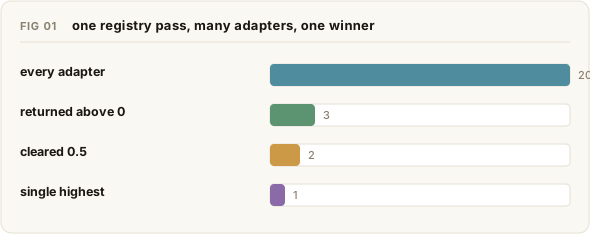
bunzai never trusts a file extension to say what a file is. It sniffs the content: every adapter inspects
the bytes or the decoded text and returns a confidence, and the registry keeps the single highest score
above a threshold. This page explains that one pass, the confidence gradient that makes a specific format
outrank a generic one, and the firewall that stops a character reader from claiming a lorebook.
For the hub-and-spoke model this detection feeds, see architecture.md. For one
format's detect paths in full, see formats/sillytavern.md.
Content, not extension
An adapter is handed an AdapterInput: bytes for binary formats, text for JSON, and an optionalfilename (src/core/adapter.ts:8-13). A file read fills bytes always and decodes text only when the
extension is .json or .txt and the bytes are valid UTF-8 (src/cli.ts:25-39); the studio does the same
on an upload (src/ui/server-engine.ts:57). The extension only decides whether to attempt a text decode,
never which adapter wins.
That split is why binary formats detect on bytes and JSON formats on text. A PNG card is recognized by
its embedded chara or ccv3 text chunk, a Risu .charx by the zip magic, a Backyard .byaf by its
archive bytes, while a .json card is recognized by its parsed shape. A detector that needs text returns0 when only bytes are present (src/formats/vaud-json/index.ts:29). The physical wrapper
is sniffed separately by sniffContainer, on magic bytes then a text fallback
(src/entities/character/provenance.ts:142-160).
The registry pass
src/core/registry.ts is the pure, in-memory adapter table. detect() walks every registered adapter,
calls its detect(input), and tracks the highest score; it returns that adapter only if the score clearsDETECT_THRESHOLD, otherwise undefined (src/core/registry.ts:30-41). The threshold is 0.5
(src/core/registry.ts:10), inclusive: a score of exactly 0.5 clears.
- One pass, one winner. Every adapter is scored against the same input; the best above the floor wins.
No format-to-format probing, no extension lookup. - No match is a real outcome. When nothing clears
0.5,detect()returnsundefinedand the caller
reports the file as unrecognized rather than guessing (src/cli.ts:185-192,src/cli.ts:322-326). - Selection is strict-greater, so scores are spread on purpose. The comparison is
s > score, so an
equal later score never displaces an earlier one; the confidence ladder below is chosen distinct enough
that detection never depends on registration order.
Detection is the first step of every top-level operation: bunzai convert, bunzai inspect, bunzai validate,
and bunzai label all resolve the source with registry.detect(input) before doing anything else
(src/cli.ts:185, src/cli.ts:241, src/cli.ts:286, src/cli.ts:322), and so does the studio's inspect
endpoint (src/ui/server-engine.ts:58).
Confidence scores
detect() returns a number in the range 0 to 1: 0 means "not mine", higher means more certain
(src/core/adapter.ts:43-44). The scores are hand-chosen so a more specific reader outranks a generic one
that shares the same wire shape. Three patterns cover it:
- Specific outranks generic on the same shape. SillyTavern is the generic Tavern reader and scores
0.9on a recognizable card. RoleCall shares the CCv3 wire shape but claims1.0only on a card carrying
anextensions.rolecallblock, so it wins detection for its own cards; on a plain CCv3 card RoleCall
returns0and the genericsillytavernreader takes it at0.9(src/core/detection.test.ts:28-37,src/formats/rolecall/rolecall.test.ts:64-66). This is the load-bearing gradient, and the final narrowing
in the figure above. - A weaker signal still scores in-band. Backyard scores
0.9on its own legacy card but only0.55on
a bare{ persona }object, which barely clears the floor, and0on another format's shape
(src/formats/backyard/backyard.test.ts:26-32). A low-but-positive score is a deliberate "I can read
this, weakly", not a bug. - A sub-threshold floor is a soft no. The native
vaud-jsonreader returns1for a real canonical
entity but0.1for any other parseable JSON (src/formats/vaud-json/index.ts:32). The0.1never
clears0.5, so it cannot win; it only expresses "this is at least JSON" without claiming the file.
The per-adapter scores are owned by each format page, not repeated here; for the full roster see the
generated FORMAT-SUPPORT.md, and for one family's scores in prose see
formats/sillytavern.md, "Detection".
Not detection: the origin labeler
bunzai label runs a second, separate scoring pass and reports its own confidence. Do not conflate it withdetect(). After detection has already chosen the format, labelCard guesses which app most likely
authored the card by testing app-namespaced extension blocks, and returns the winning rule's weight as a0 to 1 confidence (src/entities/character/provenance.ts:120-140, src/cli.ts:286-289). That weight
answers "where is this card from", a heuristic; detect()'s confidence answers "which adapter reads this
file", the routing decision. They are different numbers from different passes.
The cross-kind firewall
Character, lorebook, persona, and regex adapters all live in one registry and are scored in one detect()
pass. So a detector must return 0 on another kind's files, or it would steal them. This is the cross-kind
firewall (architecture.md, "The cross-kind firewall").
The load-bearing case is the character-versus-lorebook collision. A SillyTavern worldbook is also{ name, ... } JSON, so a naive V1-character path would false-positive on it. The SillyTavern character
reader's flat/v1 branch is therefore tightened to require a real character signal (description,personality, scenario, first_mes, or mes_example), which a worldbook never carries, so the
worldbook routes to sillytavern-lorebook instead (src/core/detection.test.ts:74-78; the tightening rule
is documented in formats/sillytavern.md, "Detection"). The same discipline
keeps Pygmalion, Backyard, Agnai, and the native vaud-json shapes from colliding
(src/core/detection.test.ts:48-102).
src/core/detection.test.ts is the firewall itself: it registers every format, then asserts each format's
own sample routes to exactly the right adapter. That is the property that keeps the engine modular. Dropping
in a new format folder is allowed to add a detector, but it must not silently steal detection from an
existing one, and this test is what proves it.
A second, complementary layer sits at the type level. FormatAdapter is a kind-discriminated union, andconvertFile narrows on kind before it ever calls fromCanonical, throwing on a cross-kind pair rather
than producing garbage (src/core/adapter.ts:99-106, src/convert.ts:103-114). Detection keeps the wrong
kind from being picked; the union keeps a wrong-kind call from being representable. See
architecture.md, "The adapter contract".
Adding a format never edits detection
Each format folder owns its own detect(). The registry is pure and never enumerates formats; the loader
discovers every src/formats/*/index.ts and registers what it default-exports (src/core/loader.ts:20-37,architecture.md, "Folders-as-schema"). To add a format you write its detect in the new folder and pick a
score that fits the gradient; no core file changes. The firewall test above is the safety net that catches a
score that reaches into another format's territory.
Source of truth
| Concern | File |
|---|---|
Registry table, detect(), DETECT_THRESHOLD |
src/core/registry.ts |
Adapter detect contract, kind-discriminated union |
src/core/adapter.ts |
| Folders-as-schema loader (registration order) | src/core/loader.ts |
| Cross-kind firewall property test | src/core/detection.test.ts |
| Type-level kind guard on conversion | src/convert.ts |
AdapterInput build, detect call sites |
src/cli.ts, src/ui/server-engine.ts |
| Origin labeler (separate confidence pass) | src/entities/character/provenance.ts |
| Generated adapter roster | docs/FORMAT-SUPPORT.md |