Docs / Developer / Safe archive handling: .charx and .byaf
Safe archive handling: .charx and .byaf
Both .charx (RisuAI) and .byaf (Backyard) are ZIP archives, and bunzai treats the bytes inside them as
untrusted until parsed. This page covers two properties of that handling, and they are proven to different
degrees:
- Decompression limits against a zip bomb. One shared bounded-unzip helper,
unzipBounded
(src/core/archive.ts), gates every.charxand.byafinflate. This is real, shared, and unit-tested. - Path-traversal safety on entry names. This is proven for exactly one place an untrusted entry name
can turn into a fresh write: a BYAF greeting id resolving to a scenario file on export. It is not yet
proven, and not yet tested, for two other places a name from the input archive is carried into a
re-exported archive's entry table. Both are named below, in the same breath as the parts that are solid.

Decompression limits against a zip bomb
The shared bound
CARD_ARCHIVE_BOUNDS is the budget both .charx and .byaf are unzipped under: 96 MiB max archive size,
512 total entries max, 64 MiB max per selected entry (compressed or inflated), 96 MiB max aggregate
inflated size across selected entries (src/core/archive.ts:30-36). The Risu, BYAF and Lumiverse card containers all call unzipCard
(src/core/archive.ts), which pins bounds: CARD_ARCHIVE_BOUNDS and forwards to unzipBounded. No format
reimplements the check; the single-source guard rejects a second caller that passes the card bounds itself.
Reject before any unzip call
The full compressed archive length is checked first, against maxArchiveBytes, before unzipSync is
called at all (archive.ts:71-73). An archive over 96 MiB never reaches fflate.
Pre-inflate, per entry
For entries fflate is about to consider, unzipBounded passes fflate an UnzipFileInfo filter callback
(archive.ts:80-100). fflate documents this filter as running during, and gating, extraction: whether the
callback returns true decides whether that entry gets decompressed at all (fflate UnzipFileFilter,node_modules/fflate/lib/index.d.ts:1403-1408). Inside that callback, before any bytes are inflated:
- A running total-entry count is checked against
maxEntriesbefore the detection-only or caller-supplied
selection filters run. Filtered entries still consume this budget, so a tiny archive with a hostile
directory count cannot make synchronous detection enumerate without a bound. - Compressed size (
f.size, straight from the ZIP's own metadata) and declared original size
(f.originalSize, falling back to the compressed size whenoriginalSizeis missing or not a valid
non-negative number,entryOriginal,archive.ts:55-60) are checked againstmaxEntryCompressedandmaxEntryOriginalfor selected entries. Either one over budget throwsArchiveLimitError. - A running sum of declared original sizes is checked against
maxAggregateOriginalfor selected entries.
An entry that fails options.only (a single named entry, used for detection) is skipped by returningfalse before its size contributes to the selected-entry budgets, so it is never inflated. It has already
contributed to the total-entry budget.
Post-inflate, as a backstop
After unzipSync returns, unzipBounded walks the actual returned bytes a second time: per-entrydata.byteLength against maxEntryOriginal, and a running actual aggregate againstmaxAggregateOriginal and maxEntries (archive.ts:106-117). This is what catches an entry whose
declared originalSize understated its real inflated size: the ZIP format lets a writer put whatever it
wants in that metadata field, so a hostile archive can claim a small original size and still inflate to
something much larger.
Be precise about what this backstop does and does not buy. By the time it runs, unzipSync has already
synchronously inflated every filter-accepted entry into memory; the recheck discards the oversized result
and throws, but it cannot stop the allocation that already happened. The 64 MiB maxEntryCompressed cap
bounds how much compressed input any one entry can carry, and raw DEFLATE's compression ratio has a
practical ceiling (on the order of 1000:1 for a pathological stream), so the worst case for a single entry
that lies about its original size is a large but bounded transient spike, not an unbounded one. There is no
evidence in this codebase of a streaming or incrementally-capped inflate that would reject such an entry
mid-decompression instead of after. No test in src/core/archive.test.ts constructs an entry whose declaredoriginalSize is smaller than its actual inflated size, so this specific backstop path is exercised by
review, not by a test.
Fail closed on any read error
Anything unzipSync throws that is not already an ArchiveLimitError (a malformed ZIP, an unsupported
compression method, a truncated stream) is caught and rewrapped as ArchiveLimitError("archive could not be read safely") (archive.ts:101-104). There is no partial-success path out of unzipBounded: either it
returns a fully-bounded Record<string, Uint8Array>, or it throws.
Callers differ in how they react to that throw, and it is worth being exact about the difference: Risu'sdetect() catches everything and reports "not this format" (src/formats/risu/index.ts:87-95), while itstoCanonical() does not catch ArchiveLimitError at all and lets it propagate to the caller
(risu/index.ts:97-99). BYAF's openByaf() catches the throw internally and returns null
(byaf-container.ts:40-44), so a zip-bomb .byaf surfaces to toCanonical() as the generic "byaf: not a valid Backyard .byaf archive" Error, not as ArchiveLimitError (src/formats/backyard/byaf.ts:303-306).
A caller that specifically checks isArchiveLimitError (archive.ts:121-123) will see it on the Risu path
and will not see it on the BYAF path; both paths fail closed, they just fail closed under different error
shapes.
Detection is bounded too
Format detection never inflates a whole archive to check its shape. Risu's detect() calls unzipCard(b, "card.json"), so unzipBounded's only filter skips every entry except card.json before any inflation
decision, while every directory entry consumes the total-entry budget and the matching entry passes the
compressed, original, and aggregate checks
(risu/index.ts:87-95). BYAF's detection reads only manifest.json the same way, throughreadManifestBytes (byaf-container.ts:142-148, called from byaf.ts:288-301). A large hostile archive
being probed for its format cannot force a full inflate or an unbounded directory scan.
The module.risum aside
A .charx can carry a module.risum sidecar. It is one more ordinary ZIP entry, so it is bounded by the
same CARD_ARCHIVE_BOUNDS as everything else in the archive; it adds no separate inflate step. Once
extracted, module.risum bytes are only ever run through RPack's byte substitution, a fixed 256-entry
table applied one byte at a time into a same-length output buffer, not a compression codec
(src/formats/risu/rpack/codec.ts:8-19). It cannot expand, so it introduces no additional zip-bomb surface
beyond the entry cap it already sits under.
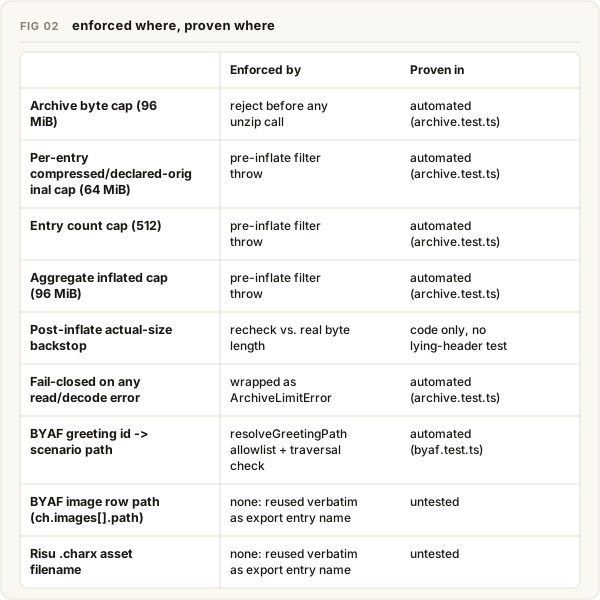
Path-traversal safety on entry names
fflate does not sanitize names
fflate's unzipSync returns each entry's name exactly as stored in the ZIP's own directory; there is no.., backslash, or absolute-path filtering anywhere in unzipBounded or in fflate itself (no such handling
exists in node_modules/fflate/esm/index.js or archive.ts). A .charx or .byaf can legally contain an
entry named, for example, ../../../evil.json, and unzipBounded will return it under that literal string
key if it fits the size and count budgets.
Ingestion never turns a name into a filesystem write
That matters less than it would in a tool that extracts a ZIP to disk, because nothing insrc/core/archive.ts, src/formats/risu/, or src/formats/backyard/ ever joins an entry name onto a real
OS path and writes it. Every entry name from unzipBounded is consumed one of two ways:
- As a key into an in-memory
Record<string, Uint8Array>that gets base64-encoded straight onto the
canonicaloriginaltwin (Risu'sassetFiles,risu/index.ts:114-125; BYAF's wholefilesmap,archiveToOriginal,byaf-container.ts:84-97), or - Reduced to just its basename before anything is decided from it (the sprite-pack ZIP importer takes
path.split("/").pop()for both the "is this an image" check and the display label,src/core/media/zip-import.ts:41,55, so a../prefix there is inert).
There is no Bun.write, writeFileSync, or fs.writeFile call anywhere in src/ that takes a zip entry
name as part of its target path (verified by search across the whole tree). A classic zip-slip, where
extracting a hostile archive overwrites a file outside the intended directory, has no code path to exploit
here today, because there is no code path that extracts an archive to disk by entry name at all.
The one place a name becomes a fresh write, and it is checked
Export can still write a new file into a re-packed .byaf, and that one path is guarded. An alternate
greeting's id can name an archive-internal scenario path (mintGreetingId,src/formats/backyard/byaf-scenarios.ts:11-15). On export, resolveGreetingPath is the only function
allowed to turn such an id back into a path, and it refuses anything shaped like traversal: an id must
start with the byaf: prefix, the remainder must not be empty, must not contain .., must not start with/, and must not contain a backslash (byaf-scenarios.ts:21-27). Even past that filter, the resolved
path is only used if it is already a member of knownPaths, the set of scenario paths that existed in the
archive's own twin before the edit (byaf-scenarios.ts:34, called from applyGreetingsToArchive,byaf-scenarios.ts:131,137). A hostile or unrecognized id can therefore at best name a scenario file that
was already legitimately part of the archive; it can never mint a new one. Any genuinely new scenario path
is generated by freshScenarioPath, which is never derived from user input at all
(byaf-scenarios.ts:38-45). This is exercised directly by test: "hostile greeting id is never used as an archive path" feeds ids containing ../../../evil.json and scenarios/../manifest.json through export and
asserts neither string appears as an output entry, and that every emitted scenario path still starts withscenarios/ and contains no .. (src/formats/backyard/byaf.test.ts:321-336).
Two places that are not checked the same way
Two other spots carry a name from the untrusted input archive into the entry table of a freshly-built
output archive, and neither has resolveGreetingPath's traversal check or a test covering the hostile
case.
- BYAF image rows.
pathForLabellooks up an existingch.images[]row by label and, on a match,
returns that row'spathfield verbatim (src/formats/backyard/byaf.ts:196-204). That value comes
straight from the archive being read, so a hostile.byafcan put an arbitrary string there. The caller
joins it onto the character directory (slashes normalized, backslashes flattened to forward slashes)
and writes it as a key into the in-memory files map,arc.files[full] = parsed.bytes
(byaf.ts:210-212), andpackByaflater zips every key in that map, unmodified, as the output entry
name (byaf-container.ts:127-139). Only the fallback filename, used when no existing row matches the
label, is sanitized (strips everything but word characters, dot, and hyphen,byaf.ts:221); a path read
from an existing row is not. - Risu
.charxasset filenames. The literal entry name captured during import
(assetFiles[path] = b64(data), iteratingObject.entries(files),risu/index.ts:114-125) is written
back as the export entry name unmodified (files[path] = unb64(s),risu/index.ts:170-171), then
passed straight tozipSync(risu/index.ts:181).
Neither of these ever becomes a real filesystem write in this codebase, for the same reason ingestion does
not: the result is bytes handed back from fromCanonical, not a set of files extracted to disk. The
residual risk is downstream: the .byaf or .charx bunzai re-exports can carry a ZIP entry whose name still
contains .., and a different, less careful tool that later unzips that exported archive by joining
entry names onto a real path could be the one that turns it into a traversal write. That is a real gap
against the goal of never re-emitting a traversal-shaped name, not a same-process exploit against bunzai
itself. Call it what it is: verified as unguarded, and untested, not "safe by design" the way the greeting-id
path is.
What is not yet proven
Proven and enforced: the pre-inflate archive-size, selected-entry size, total-entry count, and selected
aggregate caps in unzipBounded, all exercised by archive.test.ts; the fail-closed wrapping of any unzip
error into ArchiveLimitError; the only-mode selection plus total-entry cap that keeps format detection
cheap on a hostile archive;
and resolveGreetingPath's traversal-and-known-path gate on the one BYAF export write path, exercised by
a hostile-id test.
Not yet proven:
- The post-inflate size backstop exists in code (
archive.ts:106-117) but no test fabricates an entry
whose declaredoriginalSizeunderstates its real inflated size, so the specific "lying header" case it
exists to catch has not been exercised by a test, only reasoned about from the code. - The BYAF image-row path (
byaf.ts:196-204,210-212) and the Risu.charxasset filename
(risu/index.ts:114-125,170-171) carry no traversal check before becoming an export entry name, and no
test exercises a hostile path or filename on either one. Do not read the greeting-id defense as covering
these; it does not.
Do not describe archive handling in this codebase as fully sandboxed against a hostile archive, or as
having path traversal solved in general. It is solved, and tested, for one specific write path. The rest of
this page is the honest map of what still needs the same treatment.