Docs / Developer / RisuAI format
RisuAI format
RisuAI is a roleplay client whose native character export is a .charx: a ZIP archive containing acard.json (an ordinary Character Card V3) plus an assets/ tree, and optionally a module.risum
bundle. bunzai reads and writes .charx, plus RisuAI's standalone lorebook export and its customscript
regex rows, wherever they live (card-embedded, a bare JSON array, or packed inside a .risum module).
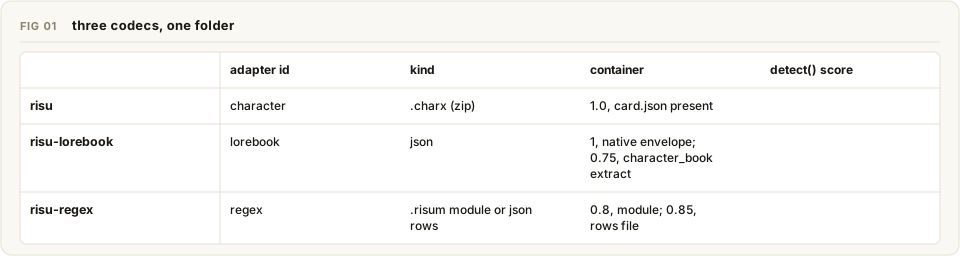
The format is one folder, src/formats/risu/, whose index.ts default-exports three codecs
(index.ts:191):
risu, kindcharacter, reads and writes.charx.risu-lorebook, kindlorebook, reads and writes the native lore export json.risu-regex, kindregex, reads a.risummodule or a barecustomscriptrow array; writes json
rows only, never a repacked module (see Quirks).
This page documents the character and lorebook codecs in full; the regex codec is covered in summary
under Quirks. For the canonical field meanings this format maps onto, see
entities/character.md and entities/lorebook.md.
For the hub-and-spoke, escrow, and detection model, see architecture.md. For the
whole matrix of formats, see FORMAT-SUPPORT.md.
Detection
Character
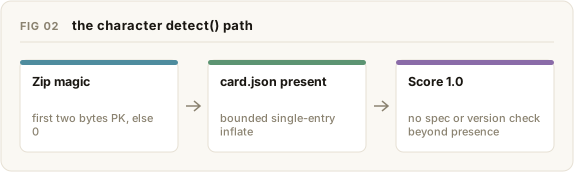
detect() returns 1.0 for a recognizable .charx, 0 otherwise (index.ts:87-95). It is a two-step
check:
- Zip magic: the first two bytes must be
PK(0x50 0x4b). Anything else scores0immediately, so
a bare JSON card is never claimed by this adapter. card.jsonpresent: a bounded, single-entry inflate (only: "card.json") scores1.0if that
entry exists,0if it does not or the archive fails to parse (index.ts:38-41,90-94).
Detection does not parse the card's spec/spec_version or inspect its contents beyond the presence ofcard.json; a .charx carrying a V2-shaped data block still scores 1.0 here.
Every inflate on this path, detection and conversion alike, runs through the core's bounded unzip
(unzipBounded with CARD_ARCHIVE_BOUNDS: max archive 96 MiB, max 512 entries, max 64 MiB per entry
compressed or inflated, max 96 MiB aggregate inflated), which rejects an oversized entry before
decompressing it rather than after (src/core/archive.ts:30-36,66-119).
Lorebook
risu-lorebook returns 1 for the native envelope, 0.75 for a portable character_book extract, 0
otherwise (lorebook.ts:299-303):
1: a top-level object withtype === "risu"and an arraydata(lorebook.ts:285-289). The shape is
unambiguous and does not collide with a SillyTavern worldbook's{ entries: {...} }object.0.75: a Chub-style or card-extractedcharacter_book(an object with anentriesarray of CCv3-shaped
rows), the same fallback the SillyTavern lorebook codec accepts (lorebook.ts:301,character-book.ts:270-284). It scores below the native envelope so a real Risu export always wins any
tie.
Field map
Character
The card.json data object maps through the shared Tavern V2/V3 mapper, identical to SillyTavern's owndata mapping: SillyTavern and Risu carry the exact same CCv3 data shape, so the mapping lives once insrc/formats/_shared/tavern-fields.ts (dataToBody on import, applyBodyToData on export,tavern-fields.ts:3-4). See sillytavern.md, "Field map" for that table in full; it is
not repeated here.
Risu's own delta lives in data.extensions.risuai, mapped by src/formats/risu/risu-fields.ts. The
whole surface is FIRST-CLASS and editable (schema-is-editor), and every write is twin-diffed so an
unedited card re-emits its risuai block verbatim:
| Canonical | Risu wire (extensions.risuai) |
Notes |
|---|---|---|
attribution.license |
license |
Scalar, write on change, delete key on clear. risu-fields.ts:140,178-182 |
bias |
bias ([phrase, weight] pairs) |
risu-fields.ts:36-44,141,183-185 |
prompts.additionalText |
additionalText |
A plain-append prompt string, distinct from a depth injection. risu-fields.ts:142-143,186 |
settings.risu.* |
viewScreen, largePortrait, inlayViewScreen, utilityBot, lorePlus |
Authored display and behavior toggles. risu-fields.ts:70-83,144-145,187-194 |
persona.imagePrompt |
sdData ([label, value] rows) + newGenData.{prompt,negative,instructions,emotionInstructions} |
risu-fields.ts:46-62,146,195-205 |
persona.voice (provider vits) |
vits |
The only TTS config confirmed to serialize on this wire. risu-fields.ts:64-68,147,206-209 |
behavior.regexScripts |
customScripts |
The narrow, card-embedded twin (singular phase, no id/enabled/sortOrder); see entities/regex.md, "The character-card twin". regex.ts:49-64 |
behavior.triggerScripts |
triggerscript |
Condition/effect rows, verbatim-editable. risu-fields.ts:88-109,116-117,216-218 |
behavior.virtualScript |
virtualscript |
risu-fields.ts:118,219 |
behavior.backgroundHTML / backgroundCSS |
backgroundHTML / backgroundCSS |
risu-fields.ts:119-120,220-221 |
behavior.defaultVariables |
defaultVariables |
Script-engine seed values. risu-fields.ts:121,222 |
behavior.prebuiltAsset |
prebuiltAssetCommand, prebuiltAssetExclude, prebuiltAssetStyle |
risu-fields.ts:122-128,225-229 |
behavior.moduleToggles |
writes toggles; reads toggles, falling back to customModuleToggle |
The producer wire key is toggles; customModuleToggle is a DB-only spelling accepted tolerantly on read. risu-fields.ts:129-132,223-224 |
behavior.privileged |
lowLevelAccess |
The card requested Risu's privileged low-level script API; a warning marker, never an execution trigger. risu-fields.ts:133,148,230-232 |
data.creation_date / data.modification_date map to attribution.createdAt / updatedAt through the
shared mapper, then get a Risu-specific unit fix: Risu writes both in milliseconds, the CCv3 spec says
seconds, so any value above 1e11 is normalized to seconds on import and the raw millisecond value is
restored verbatim on a same-format export (index.ts:30-36,111-112,154-162; see Quirks).
data.assets[] maps to canonical media through the shared CCv3 asset mapper
(src/formats/_shared/assets.ts, assetsToMedia on import, applyMediaToTavernData on export,index.ts:110,159). Asset type decides the canonical role: icon (or name === "main") becomesportrait, emotion/expression becomes emotion, outfit/pose/background map straight across,
anything else (including Risu's own x-risu-asset) becomes other (assets.ts:69-78,113-131). The
asset bytes are not at the mapped ref; they ride escrow separately (see
Escrow and round-trip).
data.character_book is not mapped by the Tavern mapper. An embedded book is a bundle concern: on import
a shared layer extracts it into a standalone CanonicalLorebook and links it via knowledgeRefs
(src/convert.ts:49, format-agnostic for any CCv2/v3 card); on export fromCanonical(entity, context)
re-embeds a referenced lorebook into data.character_book via the same embedCharacterBook helper
SillyTavern and RoleCall use. A resolved empty list removes both possible character_book slots instead
of preserving the archive twin's stale copy (index.ts:164-168, character-book.ts:462-478).
Lorebook
Risu's native field names differ from CCv3. key and secondkey are comma-joined strings, not arrays.
Canonical (LorebookEntry) |
Risu native (loreBook) |
Notes |
|---|---|---|
id |
id |
Falls back to the raw row's array index. lorebook.ts:106 |
title |
comment |
Falls back to Entry N when blank. lorebook.ts:103,107 |
comment |
comment |
Risu writes the same string to both name and comment on its CCv3 form; mirrored here. lorebook.ts:109 |
content |
content |
lorebook.ts:108 |
constant |
alwaysActive |
The always-on flag, not mode. lorebook.ts:112 |
triggers |
key (comma-joined) |
Split on commas, trimmed, empties dropped; /pattern/flags decodes to a structured trigger; useRegex forces every keyword to regex. lorebook.ts:82-84,91-99,115 |
secondaryTriggers |
secondkey (comma-joined) |
Present only when selective is true. lorebook.ts:101-102,116 |
triggerMode |
derived | advanced when selective or a secondary key exists, else simple. lorebook.ts:114 |
caseSensitive |
extentions.risu_case_sensitive |
Risu's own spelling of "extensions". lorebook.ts:52,119 |
probability |
activationPercent |
Clamped to 0 to 100; stamped onto each trigger's own probability when not 100, matching character-book.ts's embedded-path output. lorebook.ts:92-99,138 |
sortOrder |
insertorder |
Risu treats insertorder as CCv3 insertion_order; see Quirks. lorebook.ts:127 |
priority |
(none) | Risu has no eviction axis, so priority defaults to 100. lorebook.ts:128 |
role |
role |
system, user, or assistant; the one native-richer field, see Quirks. lorebook.ts:86,125 |
enabled |
(none) | Native lore has no per-entry disable flag; always reads true. lorebook.ts:111 |
categoryId |
folder |
Parent folder reference on a child entry. lorebook.ts:56,135 |
mode (multiple, constant, normal, child, folder), loreCache, and bookVersion have no
canonical home and ride escrow untouched. A mode: "folder" row is lifted out as a LorebookCategory
rather than a content entry; a child entry's folder becomes its categoryId (lorebook.ts:158-176).
See entities/lorebook.md for LorebookCategory and every other canonical
field's meaning; the entry-level fields not in the table above (positions, per-entry scan depth, groups,
timing, recursion, scan sources) are absent from the native wire and take canonical defaults.
The envelope carries no book-level name or settings: in Risu those live on the character record
(loreBookDepth/loreBookToken), not in the exported file, so the canonical book name is empty and
global scan depth/budget default to 0 (lorebook.ts:177-193).
The same Risu lore must canonicalize identically whether it arrives here as a native envelope or embedded
in a .charx (which routes through _shared/character-book.ts): Risu's own writer equates the two
field-for-field, which is why insertorder lands in sortOrder, not priority, matching the embedded
path (lorebook.ts:10-21).
Escrow and round-trip
The escrow envelope is the canonical wrapper's original field, a Record<FormatId, OriginalEntry> keyed
by format id (canonical.ts:39-48,80). The architecture calls this concept "escrow"; the wrapper field is
named original. The character twin lives at original.risu, the native lorebook twin atoriginal["risu-lorebook"].
On import the character adapter stores the whole parsed card.json envelope, the non-card.json zip
entries, the module.risum bundle if present, and two safety flags (index.ts:130-147):
original.risu = {
  raw:      <the parsed card.json envelope: spec, spec_version, and the full data block>,
  unmapped: {
    assetFiles:          { "<zip path>": "<base64>", ... },  // every entry but card.json/module.risum
    moduleRisum:         "<base64>",                          // module.risum bytes, when present
    module:              <OpenedRisumModule>,                 // structured view, only when decode succeeds
    hasExecutableContent: boolean,
    privileged:           boolean,
  },
}
A Risu to canonical to Risu round-trip is data-lossless. On export, fromCanonical clonesoriginal.risu.raw, or starts from a from-scratch V3 envelope (baseCard()) when there is no twin
(index.ts:49-56,152). In order: applyBodyToData overlays the shared scalar fields with the same
three-state clear/write/leave rule the SillyTavern codec uses; applyMediaToTavernData merges canonical
media back into data.assets[] (see Quirks for what survives cross-format); applyBodyToRisu
twin-diffs the extensions.risuai scalar surface; the raw millisecond dates are then restored verbatim
over whatever applyBodyToData wrote in seconds (index.ts:154-162). card.json is re-serialized withJSON.stringify(card, null, 4), the escrowed asset files are restored byte-for-byte at their original zip
paths, module.risum is re-emitted (unedited bytes verbatim, an edited module refused, see
Quirks), and the set is re-zipped (index.ts:167-181). Every mapped field, every asset byte,
and module.risum survive, but the output .charx bytes are not guaranteed to equal the input: the JSON
is re-serialized and the zip is regenerated, so indentation, compression, entry order, and archive
metadata are reproduced by bunzai, not preserved from the source.
The native lorebook codec follows the same twin-overlay rule. The whole raw envelope ridesoriginal["risu-lorebook"].raw (lorebook.ts:314). fromCanonical walks the twin's rows in original
order, matched by id: an unedited entry or folder row re-emits from its clone field for field (comma
spacing, mode/folder/loreCache residue all intact); an edited entry rewrites only the fields that
changed; a canonically deleted row drops out; a canonically added entry or category with no twin appends
fresh (entryToWire/bookToWire, lorebook.ts:209-280). Book-level metadata a native envelope cannot
hold (name, description, scan depth, token budget) is not written on export, since Risu keeps it on the
character record, not in the file.
Repeated content-entry ids receive stable unique canonical ids and rejoin their source rows by that
same assignment on export. Folder rows use a separate id namespace, so a category may share an id with
an entry without suppressing either row. Rows that had no source id remain without one on export.
Quirks
- Always CCv3, never V2. Risu's
card.jsonis written withwrapV3; a from-scratch export with no twin
starts frombaseCard(), which is also V3 (index.ts:49-56). There is no V2 branch to preserve, unlike
the SillyTavern codec. - Millisecond dates. Risu writes
creation_date/modification_datein milliseconds; CCv3 says seconds.
Any value above1e11normalizes to seconds on import (a real seconds timestamp does not reach that
until roughly the year 5138), and the raw millisecond value is restored verbatim on a same-format
export. The sample fixture deliberately mixes units in one card,creation_datein milliseconds andmodification_datealready in seconds, confirming the fix has to run per field, not per card
(index.ts:30-36,samples/risu/SOURCES.md). - Media now crosses format, selectively.
fromCanonicalalways callsapplyMediaToTavernData, the
inverse ofassetsToMedia. What survives depends on the ref:data:inline images,http(s)://URLs,
and theccdefault:sentinel project straight intodata.assets[]; an archive-relative ref
(embeded://...,blob:,file:, or any bare path with no scheme) is skipped unless an existing row
on the twin already carries that exact uri, since there is no zip to resolve a fresh one against
(assets.ts:134-146,231-273,307-321). A same-format Risu round-trip keeps every asset because its
twin's rows already carry the matching uri and the bytes rideoriginal.risu.unmapped.assetFiles. - Behavior is first-class editable data, never executed.
CharacterBehavior(regex scripts, trigger
scripts, virtual script, background markup, module toggles,privileged) is a real canonical slot, not
escrow. No adapter'sfromCanonicaloutside this folder readsbody.behavior, so it only ever re-emits
on the Risu wire; a Risu-to-anything-else export carries no scripts. Execution itself is out of scope
for the whole converter: no eval, no require, no DOM injection anywhere in the pipeline. module.risumis opened, not opaque, but re-encoding an edit is safe-blocked. A.risumis Risu's
RPack container: magic byte111, version byte0, a length-prefixed main JSON block byte-substituted
through a fixed 256-entry table (no compression, no key), zero or more length-prefixed asset blocks, and
a terminator (rpack/container.ts:15-18,42-76,rpack/codec.ts:9-19). bunzai reimplements the container
walk and the table clean-room insrc/formats/risu/rpack/, andopenRisumModuledecodes it into a
structuredRisuModule(name,trigger[],regex[],lorebook[], an openextrasbag, plus a listing
of everytriggerlua/cjs/triggercodescript body without reading its meaning), landing atoriginal.risu.unmapped.module(open-module.ts:26-48,rpack/module.ts:46-56,61-86). An unedited
module always re-exports its original bytes byte-for-byte. An edited one throwsRpackEditedExportBlockedErrorinstead of writing through the table unproven under a real edit; the
gate (RPACK_EDITED_EXPORT_VERIFIED) flips only once independent ciphertext/plaintext fixtures cover the
exercised mappings (rpack/index.ts:37-57,112-117).risu-regexcovers two file homes with two different scores, and export is rows-only.detect()
returns0.8for a.risummodule blob whose decodedregex[]is non-empty,0.85for a bare JSON
array ofcustomscriptrows carrying at least one oftype/comment/flag/ableFlag/disabled
(regex.ts:227-266); a.charxzip still scores1.0on the character adapter, so a full card keeps
importing as a character, not a regex set. Rows decode withid/sortOrderset to the row's original
array index (Risu rows carry no id of their own),enabledread tolerantly (disabled === trueis the
only "off"), and every unrecognized key preserved inextras(regex.ts:113-135). Export always emits
a pretty-JSON row array, never a repacked.risum, even when the twin came from a module: a module
carries triggers, lorebook entries, and assets this entity has no home for, so wrapping bare rows back
into one would fabricate wire data (regex.ts:209-221,284-288). An unedited rule re-emits byte-for-byte
through the same twin-overlay walk the lorebook codec uses, including preserving whichevertype
spelling was on the wire;RISU_TYPE_TO_PHASEmapseditinput/editoutput/editdisplayplus both
observed request spellings,editrequestandeditprocess, to canonical phaserequest, and only a
freshly authoredrequestphase writes the current, source-confirmededitprocessspelling
(regex.ts:22-30,94-109,144-173). An unlistedtypevalue (edittrans, observed on a real card) is
kept verbatim as an unmodeled phase string rather than rejected, since canonicalRegexPhaseis an open
union; an omittedtypedecodes to an emptyphasesarray rather than an invented default, matching
Risu's own strict-equality pipeline dispatch, which never runs an untyped row either
(regex.ts:15-20,113-115).- The native lorebook's
rolefield is native-richer. Risu's own.charxexport drops per-entryrole
when it writescharacter_book, but the native lorebook export keeps it, so it is mapped here even
though the embedded path has no equivalent (lorebook.ts:17-18,86,125). - Placement order crosses cleanly.
insertordermaps to canonicalsortOrder, the same axis every other
codec's placement field maps to (SillyTavernorder, CCv3insertion_order), never topriority
(which Risu has no field for and always defaults to100). Arisu-lorebooktosillytavern-lorebook
conversion therefore writes the insertion order straight into ST'sorder
(lorebook.ts:127-128, sillytavern.md, "Field map").
Source of truth
| Concern | File |
|---|---|
| Character adapter (detect, container, escrow, dates, safety flags) | src/formats/risu/index.ts |
| Risuai extension scalar mapping | src/formats/risu/risu-fields.ts |
| Native lorebook codec | src/formats/risu/lorebook.ts |
| Regex codec (card-embedded twin + standalone entity mapping) | src/formats/risu/regex.ts |
.risum (RPack) container walk, byte codec, substitution table, module JSON |
src/formats/risu/rpack/container.ts, codec.ts, table.ts, module.ts, index.ts |
| Structured module open view (for escrow) | src/formats/risu/open-module.ts |
| Shared Tavern V2/V3 field map | src/formats/_shared/tavern-fields.ts |
| Shared CCv3 asset to media map | src/formats/_shared/assets.ts |
Shared keyword /pattern/flags decode + embedded character_book mapper |
src/formats/_shared/character-book.ts |
| Coverage declaration | src/formats/risu/coverage.ts |
Canonical wrapper, escrow (original), id policy |
src/core/canonical.ts |
| Bounded zip inflate | src/core/archive.ts |
| Samples | samples/risu/ (test-risu.card.json + SOURCES.md) |