Docs / Developer / Character entity
Character entity
A CanonicalCharacter is CanonicalEntity<"character", CharacterBody>: the stable canonical wrapper
(see architecture.md) around a CharacterBody, the superset shape that unions
what every real character format expresses. src/entities/character/schema.ts is the source of truth
for the types; this page is the source of truth for what each field MEANS and which formats produce it.
How to read the field tables
The field tables on this page are generated from the schema by scripts/docs-fields.ts and embedded
verbatim. Do not hand-edit a cell: improve the schema doc comment and regenerate, and the docs follow.
- Field is the canonical name. A trailing
?marks an optional field. - Type is the TypeScript type in the schema.
- Producers are the source formats named in the field's schema doc comment. A
-means the doc
comment names no specific producer. Many such fields are the universal core every format carries
(name,personality,scenario,systemPrompt,tags); others simply have their provenance
described in prose rather than tagged inline. - Meaning is what the field is for. A blank Meaning cell is a self-evident primitive named by its
own field, and marks a field the schema doc comment did not annotate. Non-obvious fields carry their
meaning from the schema doc comment. Any richer explanation lives in the prose around a table, never
inside a cell.
Composition
CharacterBody groups its fields into eight always-present sub-objects (identity, persona,prompts, greetings, examples, media, attribution, discovery) plus eight optional fields:
three further sub-objects (presentation, settings, behavior) and five standalone fields
(bias, worldName, knowledgeRefs, behaviorRefs, variants). Grouping keeps related fields
together and mirrors how a card is authored, not how any one app stores it. The full CharacterBody
and CharacterVariant tables are in Composition and variants at the end.
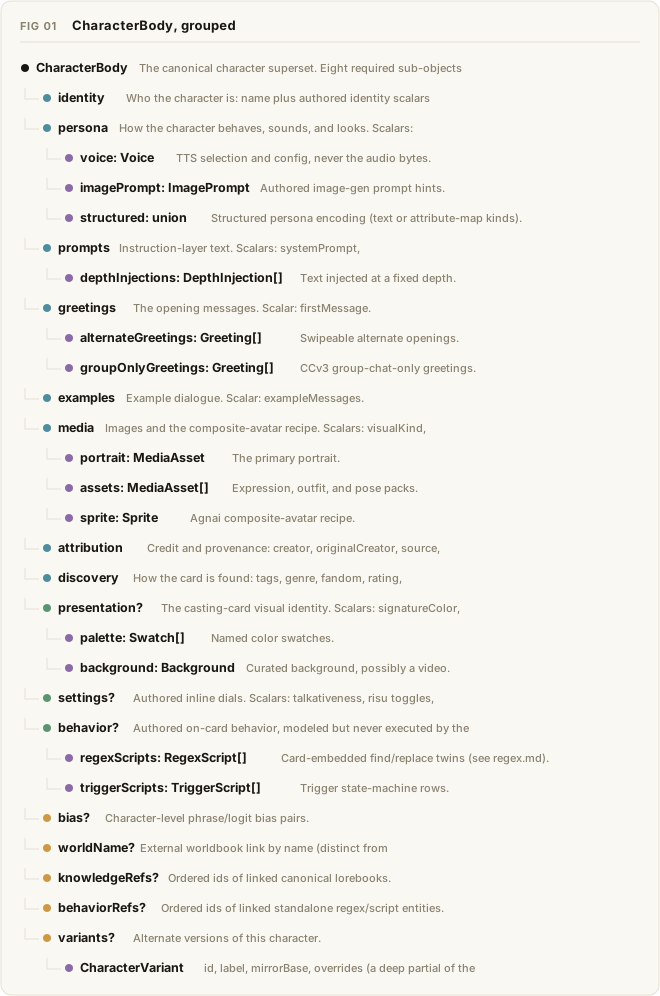
The sections below walk each group. Every field table is pasted verbatim from
docs/generated/fields.character.md.
Identity
Who the character is: the canonical name plus authored identity attributes (RoleCall casting-card
details and Agnai culture). {{char}} resolves to name; nickname overrides the display name
without changing the canonical name.
| Field | Type | Producers | Meaning |
|---|---|---|---|
name |
string |
- | |
nickname? |
string |
CCv3, Risu, Backyard | {{char}} override that does NOT change the canonical name (Risu/Backyard aiName, CCv3 nickname) |
tagline? |
string |
- | short one-liner / creator comment |
description? |
string |
CCv2/v3 | the main character description / persona block (CCv2/v3 description) |
characterVersion? |
string |
- | |
fullName? |
string |
RC | full/formal name distinct from the display name (RC details.full_name) |
title? |
string |
RC | honorific / role title (RC details.title) |
age? |
string |
RC | free TEXT in every producer ("23", "ageless", "300+ years"), never an int (RC details.age) |
pronouns? |
string |
RC | RC details.pronouns |
culture? |
string |
Agnai | Agnai culture: drives default language/voice selection |
Persona and voice
How the character behaves, sounds, and looks. persona carries the core behavior text (personality,scenario, appearance) and nests two authored sub-shapes plus a structured encoding: voice (aVoice, the TTS selection, never the audio bytes), imagePrompt (an ImagePrompt, the creator's
image-gen hints), and structured (a discriminated union that preserves attribute maps such as W++).
| Field | Type | Producers | Meaning |
|---|---|---|---|
personality? |
string |
- | |
scenario? |
string |
- | |
appearance? |
string |
Agnai | Agnai-only free-text physical description (image-gen); other formats fold it into description |
voice? |
Voice |
Risu, Agnai | per-character voice/TTS selection (Agnai voice, Risu vits) |
imagePrompt? |
ImagePrompt |
Risu, Agnai | authored image-gen prompt hints (Agnai imageSettings affixes, Risu sdData/newGenData) |
structured? |
| { kind: "text" } | { kind: "attributes" | "wpp" | "sbf" | "boostyle"; attributes: Record<string, string[]> } |
Agnai | structured persona encoding (Agnai persona.kind + attributes); preserves W++/attribute maps. Discriminated so illegal states are unrepresentable: plain "text" carries no attributes; every attribute-map kind requires its attributes. |
Voice
The authored voice/TTS selection and its config, not the model bytes (those are assets or escrow).
| Field | Type | Producers | Meaning |
|---|---|---|---|
provider |
string |
- | open union: "elevenlabs" | "webspeechsynthesis" | "novel" | "agnaistic" | "vits" | ... |
voiceId? |
string |
- | |
rate? |
number |
- | |
pitch? |
number |
- | |
disabled? |
boolean |
Agnai | creator turned voice off without discarding the config (Agnai voiceDisabled) |
extras? |
Record<string, unknown> |
- | provider-specific extras (stability, similarityBoost, model seed, vits config...) - authored, open |
ImagePrompt
The text a creator writes to steer image generation for this character. Sampler and provider knobs are
platform config and are not modeled here.
| Field | Type | Producers | Meaning |
|---|---|---|---|
prompt? |
string |
Risu | full base prompt (Risu newGenData.prompt) |
prefix? |
string |
- | |
suffix? |
string |
- | |
negative? |
string |
- | |
template? |
string |
Agnai | prompt template (Agnai imageSettings.template) |
instructions? |
string |
Risu | freeform instruction text (Risu newGenData.instructions) |
emotionInstructions? |
string |
Risu | emotion-pack generation instructions (Risu newGenData.emotionInstructions) |
rows? |
{ label: string; value: string }[] |
Risu | labeled prompt rows (Risu sdData: [["always","solo, 1girl"], ...]) |
Prompts and injections
Instruction-layer text sent to the model.
| Field | Type | Producers | Meaning |
|---|---|---|---|
systemPrompt? |
string |
- | |
postHistoryInstructions? |
string |
SillyTavern | the "jailbreak" / post-history slot in SillyTavern |
depthInjections? |
DepthInjection[] |
- | |
prefill? |
string |
Agnai | assistant-response prefill, prepended to the model reply (Agnai; common with Claude) |
additionalText? |
string |
Risu | authored plain-append prompt text (Risu additionalText) - a simple append, not a depth injection |
DepthInjection
Text injected at a fixed depth in the chat. origin records which source mechanism produced the
injection so it re-emits to its original home on export.
| Field | Type | Producers | Meaning |
|---|---|---|---|
text |
string |
- | |
depth |
number |
- | |
role? |
"system" | "user" | "assistant" |
- | |
origin? |
"depth_prompt" | "rolecall_details" | "worldinfo" |
- | which source mechanism produced this, so it re-emits to its original home on export |
enabled? |
boolean |
- | creator toggle; undefined = enabled |
Greetings and examples
The opening messages and example dialogue.
| Field | Type | Producers | Meaning |
|---|---|---|---|
firstMessage? |
string |
- | |
alternateGreetings? |
Greeting[] |
- | |
groupOnlyGreetings? |
Greeting[] |
CCv3 | CCv3 group-chat-only greetings, distinct from alternateGreetings |
Greeting
One greeting with an optional creator-given title. id is format-local editing provenance, not
portable content: other format writers emit only text and title.
| Field | Type | Producers | Meaning |
|---|---|---|---|
text |
string |
- | |
title? |
string |
- | |
id? |
string |
- | stable editing identity (format-local provenance); not user-facing content |
Examples
| Field | Type | Producers | Meaning |
|---|---|---|---|
exampleMessages? |
string |
- | mes_example |
Media
Images attached to the card, plus the Agnai composite-avatar recipe. Image bytes live in the entity's
asset store or as data URIs; these shapes hold the references and the authored recipe.
| Field | Type | Producers | Meaning |
|---|---|---|---|
portrait? |
MediaAsset |
- | |
assets? |
MediaAsset[] |
RoleCall, Risu | extra images / expression + outfit + pose packs (Risu .charx, RoleCall sprites) |
sprite? |
Sprite |
Agnai | Agnai composite-avatar recipe (visualType "sprite") |
visualKind? |
string |
Agnai | which visual mode the creator chose: "avatar" | "sprite" (open; Agnai visualType) |
faceLabel? |
string |
- | Preferred expression-pack label for this body (or variant override). Display binds the portrait stage to that pack face when present; not a second asset store. |
MediaAsset
One image reference and what it is for.
| Field | Type | Producers | Meaning |
|---|---|---|---|
role |
"portrait" | "emotion" | "outfit" | "pose" | "background" | "other" |
- | |
name? |
string |
- | |
label? |
string |
RoleCall | human label for an expression/outfit/pose variant (RoleCall sprite label) |
primary? |
boolean |
- | the primary asset of its role (e.g. the "main" portrait among many) |
ref |
string |
- | reference into the entity's asset store, or a data URI |
mime? |
string |
- |
Sprite
The Agnai builder-authored composite avatar: named part selections plus palette. The rendered images
are assets; this is the authored recipe.
| Field | Type | Producers | Meaning |
|---|---|---|---|
parts |
Record<string, string> |
- | |
gender? |
string |
- | |
eyeColor? |
string |
- | |
bodyColor? |
string |
- | |
hairColor? |
string |
- |
Presentation
The casting-card presentation layer: a creator's visual identity for the character. Optional; formats
without a presentation concept omit it. A single solid signature rides signatureColor; a 2 to 3 color
blend rides gradientColors.
| Field | Type | Producers | Meaning |
|---|---|---|---|
signatureColor? |
string |
RC, Risu | the character's signature color when it is a single solid (RC details.signature_color, Risu theme color). A signature that is a blend rides in gradientColors instead - one concept, two storage shapes. Account-level accent color is deliberately not modeled here: it belongs to the user's account, not the card. |
gradientColors? |
string[] |
RC | the character's signature when it is a blend of 2-3 colors (RC details.gradient_colors) |
palette? |
Swatch[] |
- | |
background? |
Background |
- | |
fieldOrder? |
string[] |
- | creator-chosen display order of definition fields (bento layout) |
spoilers? |
{ mode?: string; order?: string[]; fields?: Record<string, boolean> } |
RC | spoiler / reveal-order config over the public definition fields. fields is the authored per-field boolean map (RC publicDefinitionDisplay.spoilers) - previously collapsed to mode/order and LOST. |
mediaLinks? |
string[] |
RC | creator-supplied external reference links on the casting card (RC details.media_links) |
Swatch
A named color swatch in a card's palette.
| Field | Type | Producers | Meaning |
|---|---|---|---|
label? |
string |
- | |
name? |
string |
- | |
hex |
string |
- |
Background
A creator-curated background, optionally a video with playback controls.
| Field | Type | Producers | Meaning |
|---|---|---|---|
ref |
string |
- | |
overlayOpacity? |
number |
- | |
videoPlaybackRate? |
number |
- |
Settings and behavior
Authored inline dials and authored on-card behavior. The converter and editor NEVER execute any
behavior payload: no eval, no require, no DOM injection. Execution happens only inside the capability
sandbox, a later milestone. Behavior re-emits only on its own format's wire and is never blind-copied
across formats.
| Field | Type | Producers | Meaning |
|---|---|---|---|
talkativeness? |
number |
SillyTavern | group-chat turn-frequency weight, 0..1 (SillyTavern extensions.talkativeness) |
risu? |
{ /** side-screen mode: "none" | "emotion" | "imggen" (open) */ viewScreen?: string; largePortrait?: boolean; inlayViewScreen?: boolean; utilityBot?: boolean; lorePlus?: boolean; } |
Risu | Risu authored display/behavior toggles (single-platform but creator-set, so first-class per the schema-is-editor doctrine). Grouped so the origin is obvious and other formats never emit them. |
responseSchema? |
Record<string, unknown> |
Agnai | Agnai structured-output config (json ResponseSchema): authored response-shaping the creator built in Agnai's schema editor. Carried verbatim-editable; likely migrates to the Preset entity later. |
CharacterBehavior
The card's authored scripts and background markup, carried as editable data. regexScripts are
card-embedded find/replace twins: their shape is RegexScript, defined in the regex entity and
re-exported here so there is one definition, so it has no separate table on this page. See
regex.md, "The character-card twin". privileged records that the card requested the
low-level script API; it is a warning marker and a sandbox gating input, never an execution trigger.
| Field | Type | Producers | Meaning |
|---|---|---|---|
regexScripts? |
RegexScript[] |
- | |
triggerScripts? |
TriggerScript[] |
- | |
virtualScript? |
string |
Risu | JS virtual-script payload, verbatim-editable text (Risu virtualscript) |
backgroundHTML? |
string |
Risu | custom background markup/styles, verbatim-editable text (Risu backgroundHTML/backgroundCSS) |
backgroundCSS? |
string |
- | |
defaultVariables? |
string |
Risu | script-engine seed values (Risu defaultVariables), verbatim-editable |
prebuiltAsset? |
{ command?: string; exclude?: string[]; style?: string } |
Risu | prebuilt-asset generation config (Risu prebuiltAssetCommand/Exclude/Style) |
moduleToggles? |
string |
Risu | module toggle config string (Risu customModuleToggle) |
privileged? |
boolean |
Risu | the card REQUESTED the privileged low-level script API (Risu lowLevelAccess). A warning marker for the UI and a sandbox gating input - never an execution trigger. |
TriggerScript
A trigger state-machine script: condition and effect rows, carried verbatim-editable.
| Field | Type | Producers | Meaning |
|---|---|---|---|
label? |
string |
- | |
event |
string |
Risu | the triggering event (Risu type: "output", "input", "start", ...) |
conditions |
unknown[] |
- | |
effects |
unknown[] |
- |
Attribution and discovery
Credit and provenance, and how the card is found and categorized. Note two distinct notes fields:creatorNotes is the CCv2/v3 single-language creator note, while publicNote is RoleCall's separate
public "from the creator" note shown on the card page.
| Field | Type | Producers | Meaning |
|---|---|---|---|
creator? |
string |
- | |
originalCreator? |
string |
- | |
source? |
string[] |
- | |
sourceUrl? |
string |
RoleCall | canonical/origin URL for the card (RoleCall source_url) |
license? |
string |
- | |
creatorNotes? |
string |
CCv2/v3 | single-language creator notes about the card (CCv2/v3 creator_notes) |
creatorNotesMultilingual? |
Record<string, string> |
CCv3 | localized creator notes, map<ISO 639-1, text> (CCv3 prefers this over single-language notes) |
publicNote? |
string |
RC | public "from the creator" note shown on the card page (RC creators_note; DISTINCT from creatorNotes) |
createdAt? |
number |
- | unix seconds |
updatedAt? |
number |
- |
Discovery
rating is the explicit content rating (a ContentRating: all-ages, mature, or explicit), kept
out of free-text tags.
| Field | Type | Producers | Meaning |
|---|---|---|---|
tags? |
string[] |
- | |
genre? |
string |
- | |
fandom? |
string |
- | |
rating? |
ContentRating |
- | explicit content rating; keep out of free-text tags |
contentWarnings? |
string[] |
- | optional trigger/content warnings, card-portable |
Composition and variants
CharacterBody is the top shape assembled from every group above. Two link fields are easy to confuse:worldName is the creator's intent to auto-load an external worldbook BY NAME, while knowledgeRefs
links embedded lorebooks by canonical id. behaviorRefs likewise links standalone regex/script
entities by id, as opposed to behavior, which carries script content on the card itself.
| Field | Type | Producers | Meaning |
|---|---|---|---|
identity |
Identity |
- | |
persona |
Persona |
- | |
prompts |
Prompts |
- | |
greetings |
Greetings |
- | |
examples |
Examples |
- | |
media |
Media |
- | |
attribution |
Attribution |
- | |
discovery |
Discovery |
- | |
presentation? |
Presentation |
- | creator's visual identity for the card, when the source format carries one |
settings? |
CharacterSettings |
- | authored inline behavior dials (talkativeness, ...) |
bias? |
{ phrase: string; weight: number }[] |
Risu, NovelAI | Character-level phrase/logit bias (Risu bias [phrase, weight] pairs). NOTE: a DIFFERENT axis than NovelAI's entry/category-level loreBiasGroups (rich groups, modeled on the lorebook side when its reconciled shape lands) - two homes because they are genuinely two concepts. |
worldName? |
string |
SillyTavern | authored external worldbook link by NAME (SillyTavern extensions.world): the creator's intent to auto-load the worldbook called X. Distinct from knowledgeRefs, which links embedded books by canonical id. |
knowledgeRefs? |
string[] |
- | linked canonical lorebook id(s), ordered; embedded on export where a format requires it |
behavior? |
CharacterBehavior |
Risu | authored script/behavior content carried ON the card (Risu); see CharacterBehavior's security line |
behaviorRefs? |
string[] |
ST, Lumiverse | linked canonical regex/script entity id(s) - for STANDALONE behavior files (ST/Lumiverse regex) |
variants? |
CharacterVariant[] |
RoleCall | alternate versions of this character (copied from RoleCall's variant mechanic): each OVERRIDES a subset of fields; the editor shows the base with the active one merged in. See ./variant.ts. |
CharacterVariant
An alternate version of the character. overrides is a deep partial of the body; applyVariant
(./variant.ts) deep-merges it onto the base, so a variant may change one field or a whole section. A
field counts as overridden when its key is PRESENT in overrides (set it to "" to clear); absent
keys inherit from the base.
| Field | Type | Producers | Meaning |
|---|---|---|---|
id |
string |
- | |
label? |
string |
- | |
mirrorBase? |
boolean |
RC | RC's two modes. true/undefined (mirror, default): deep-overlay the overrides, unset fields inherit from the base. false (full override): each section the variant defines REPLACES the base's whole section (base fields in it drop), untouched sections still inherit, and the character keeps a name (base name falls through when the override omits it). |
overrides |
DeepPartial<Omit<CharacterBody, "variants">> |
- | the fields this variant changes - any subset of the canonical body, deep-merged onto the base |
What rides escrow, not a field
Anything a single source format keeps but no canonical field expresses stays in escrow[formatId].raw
and survives a same-format round-trip byte-for-byte. Cross-format conversion carries only the canonical
body, so one app's private data is never copied into another app's file. See the escrow rule in
architecture.md.
Rides escrow, because it has no canonical slot: RoleCall's private ids, SillyTavern extension keys with
no canonical mapping, and other app-local layout or state. The source file's own bytes ride too: a PNG
card's pixels are kept as the escrow entry's sourceMedia carrier and served as the entity's portrait
(see architecture.md, "Binary carriers").
Does NOT ride escrow, because it is modeled: authored on-card behavior is first-classed in thebehavior field (a CharacterBehavior: regex scripts, trigger scripts, virtual script, background
markup, and so on). It is carried as editable data, re-emits only on its own format's wire, and is
never executed by the converter or editor.
See also
- architecture.md: the canonical model, escrow, hub-and-spoke, the adapter contract.
- entities/lorebook.md: the canonical lorebook superset, linked from
knowledgeRefs. - entities/regex.md: the regex/script entity, linked from
behaviorRefs, and theRegexScriptcard twin. - concepts/character-book.md: how an embedded
character_bookis extracted and re-embedded. - formats/README.md: the coverage matrix of every format and the fields it produces.