Docs / Developer / Persona entity
Persona entity
A CanonicalPersona is CanonicalEntity<"persona", PersonaBody>: the stable canonical wrapper (see
architecture.md) around a PersonaBody, the superset shape that unions what every
real persona format expresses. A persona is the USER's identity, not the AI's: the counterpart to a
character, sharing the same prompt-injection machinery but speaking in the opposite voice, first person
as {{user}} instead of third person as {{char}}. src/entities/persona/schema.ts is the source of
truth for the types; this page is the source of truth for what each field MEANS and which formats
produce it.
How to read the field tables
The field tables on this page are generated from the schema by scripts/docs-fields.ts and embedded
verbatim. Do not hand-edit a cell: improve the schema doc comment and regenerate, and the docs follow.
- Field is the canonical name. A trailing
?marks an optional field. - Type is the TypeScript type in the schema.
- Producers are the source formats named in the field's schema doc comment. A
-means the doc
comment names no specific producer. Many such fields are the universal core every producer carries
(name,content,brief); others simply have their provenance described in prose rather than
tagged inline. - Meaning is what the field is for. A blank Meaning cell is a self-evident primitive named by its
own field, and marks a field the schema doc comment did not annotate. Non-obvious fields carry their
meaning from the schema doc comment. Any richer explanation lives in the prose around a table, never
inside a cell.
Composition
PersonaBody is flatter than CharacterBody: two fields are required (name, content), and eleven
further fields are optional. Six of those optional fields nest a named shape (sections, identity,presentation, chatInjection, attribution, media); the rest are scalars or reference lists. The
full PersonaBody table is in PersonaBody at the end.
Four adapters produce personas today: RoleCall in two shapes, SillyTavern, Lumiverse, and Marinara. A
legacy RoleOut PNG shape and a generic foreign-V2/V3-card-as-persona path are planned
but have no shipped adapter; formats/rolecall.md
lists both explicitly as pending.
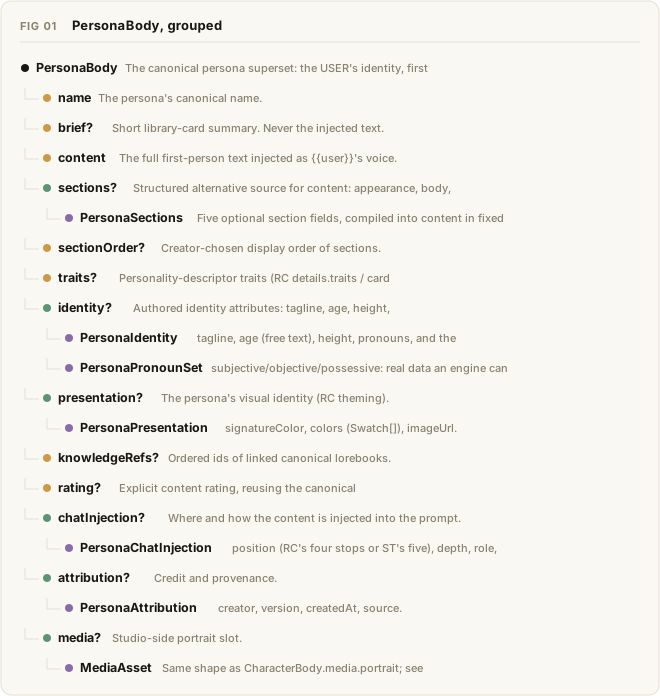
The sections below walk each nested shape, grouped by concern. Every field table is pasted verbatim from
docs/generated/fields.persona.md.
Core content
The persona's own voice, and how it is found on a shelf. name is the canonical identifier; brief is
the short library-card blurb and is NEVER the injected text; content is the full first-person text
actually injected as {{user}}'s voice. Getting brief and content swapped was a live RoleCall
production bug; every codec on this page replicates the fix, not the bug. sectionOrder records the
creator's chosen display order for sections; traits are personality-descriptor tags (RCdetails.traits / card tags).
sections is a structured alternative source for content. Canonical keeps both, unlike the source
formats' own "content wins, sections ignored" read rule, so the editor can offer structured editing even
when the source was flat text. Compiling sections into content is a codec's job at serialize time, in
the fixed order appearance, body, personality, quirks, history, each rendered as an"<Label>: <text>" block.
Sections
| Field | Type | Producers | Meaning |
|---|---|---|---|
appearance? |
string |
- | |
body? |
string |
- | |
personality? |
string |
- | |
quirks? |
string |
- | |
history? |
string |
- |
Identity
Authored identity attributes, RoleCall's casting-card details. pronouns is a free-text display
string, kept for RC/ST round-trip; pronounSet is Lumiverse's structured triplet, real data an engine
can conjugate with, additive and absent everywhere else.
| Field | Type | Producers | Meaning |
|---|---|---|---|
tagline? |
string |
- | |
age? |
string |
- | free TEXT ("23", "ageless"), never an int |
height? |
string |
- | |
pronouns? |
string |
- | |
pronounSet? |
PersonaPronounSet |
- |
Pronoun set
| Field | Type | Producers | Meaning |
|---|---|---|---|
subjective |
string |
- | |
objective |
string |
- | |
possessive |
string |
- |
Presentation
The persona's visual identity, RoleCall theming. imageUrl is an external image URL for a JSON export;
a PNG export instead carries the image as the file body itself, the same binary-carrier pattern
architecture.md describes for character portraits. colors reuses character'sSwatch shape (see entities/character.md).
| Field | Type | Producers | Meaning |
|---|---|---|---|
signatureColor? |
string |
- | |
colors? |
Swatch[] |
- | |
imageUrl? |
string |
- | external image URL (JSON export) - PNG exports carry the image as the file body instead |
Knowledge, rating, and chat injection
knowledgeRefs links canonical lorebook ids, ordered: the same reference-not-inline rule asCharacterBody.knowledgeRefs, an embedded book is never copied in. rating reuses the canonicalContentRating (see entities/character.md); RoleCall's own wire is a two-way
boolean (all_hours / after_dark), so a canonical mature rating narrows to after_dark on export to
RC, a documented, one-way loss.
chatInjection is where and how the content is injected into the prompt. Two dialects share the oneposition slot: RoleCall's four stops (world, character, scene, depth) and SillyTavern's five
(prompt, author_note_top, author_note_bottom, in_chat, none), plus an open string for anything
else. wrapper is RoleCall's custom text prepended to the injected block. Which stops a given
platform's editor lens shows is decided in core/persona/platform-fields.ts (injectionsForProfile),
never hardcoded in the UI.
| Field | Type | Producers | Meaning |
|---|---|---|---|
position |
| "prompt" | "author_note_top" | "author_note_bottom" | "in_chat" | "none" | "world" | "character" | "scene" | "depth" | (string & {}) |
- | |
depth? |
number |
- | |
role? |
"system" | "user" | "assistant" |
- | |
wrapper? |
string |
RC | RC's custom wrapper text prepended to the injected block (injection_prefix). |
Attribution
Credit and provenance. source is an open origin-platform tag ("rolecall", "sillytavern","custom", ...). createdAt is ISO 8601 text here, not the unix-seconds numberCharacterBody.attribution.createdAt uses: the rcpersona wire itself carries a string.
| Field | Type | Producers | Meaning |
|---|---|---|---|
creator? |
string |
- | |
version? |
string |
- | |
createdAt? |
string |
- | ISO 8601 (the rcpersona wire carries strings, not unix seconds) |
source? |
string |
- | origin platform tag ("rolecall", "sillytavern", "custom", ...) |
Media
Studio-side only. media.portrait is the same slot CharacterBody.media.portrait fills: the studio
portrait resolver reads it, a data-URI MediaAsset from an in-editor upload (see
entities/character.md). Codecs map explicit fields only, so this field never
leaks into a foreign wire.
PersonaBody
The full shape, assembled from every field above.
| Field | Type | Producers | Meaning |
|---|---|---|---|
name |
string |
- | |
brief? |
string |
- | short user-facing summary (library card blurb) - NEVER the injected text |
content |
string |
- | the full first-person text injected as {{user}}'s voice |
sections? |
PersonaSections |
- | structured alternative source for content. Canonical keeps BOTH (unlike the source formats' "content wins, sections ignored" read rule) so the editor can offer structured editing even when the source was flat; compiling sections into content happens in codecs at serialize time. |
sectionOrder? |
string[] |
- | creator-chosen display order of sections |
traits? |
string[] |
RC | personality-descriptor traits (RC details.traits / card tags) |
identity? |
PersonaIdentity |
- | |
presentation? |
PersonaPresentation |
- | |
knowledgeRefs? |
string[] |
- | linked canonical lorebook id(s), ordered - same reference-not-inline rule as CharacterBody |
rating? |
ContentRating |
RC | reuses the canonical graded rating (RC all_hours -> "all-ages", after_dark -> "explicit") |
chatInjection? |
PersonaChatInjection |
- | |
attribution? |
PersonaAttribution |
- | |
media? |
{ portrait?: MediaAsset } |
- | Same slot as CharacterBody: the studio portrait resolver reads media.portrait (a data-URI MediaAsset from in-editor upload). Studio-side; codecs map explicit fields only, so this never leaks into a foreign wire. |
What rides escrow, not a field
Anything a single source format keeps but no canonical field expresses stays inoriginal[formatId].raw and survives a same-format round-trip byte-for-byte. Cross-format conversion
carries only the canonical body, so one app's private data is never copied into another app's file. See
the escrow rule in
architecture.md.
Rides escrow, because it has no canonical slot: RoleCall's private ids and any unmappedextensions.rolecall keys on the twin card. Every OTHER persona in a SillyTavern personas backup rides
too, since the adapter contract is one entity per file, toCanonical imports only the default persona
(falling back to the first), and export overlays the edited persona back onto the sealed backup so the
rest re-emit byte-true. Lumiverse's folder, is_narrator, metadata, and timestamps ride the twin
untouched. Marinara's whole game layer rides sealed: per-persona chat theming (name, dialogue, and box
colors, tracker paint), stat bars, avatar crop, tags, and scenario, a field its own section map gives
no canonical home.
Does NOT ride escrow, because it is modeled: Lumiverse's structured pronoun triplet is first-classed asidentity.pronounSet; SillyTavern's injection positioning is first-classed as chatInjection;
RoleCall's sections, identity attributes, and presentation are first-classed as sections, identity,
and presentation. Each survives cross-format conversion instead of being trapped in one app's escrow.
See also
- architecture.md: the canonical model, escrow, hub-and-spoke, the adapter contract.
- entities/character.md: the sibling superset entity; shares
ContentRating,Swatch,
andMediaAsset. - formats/rolecall.md: the RoleCall persona codec, both shapes, and the
cross-kind firewall against the character adapter. - formats/sillytavern.md: the SillyTavern personas-backup codec.
- formats/README.md: the coverage matrix of every format and the fields it
produces.