Docs / Developer / Pack entity
Pack entity
A CanonicalPack is CanonicalEntity<"pack", PackBody>: the same stable canonical wrapper (see
architecture.md) every entity uses, around a PackBody. src/entities/pack/schema.ts
is the source of truth for the PackBody type; this page is the source of truth for what each field means.
Pack is also the canonical target of the image-pack adapter. It reads a ZIP of supported pictures and
sounds, or a single supported raster image, into one reusable pack. A pack is stored atstudio/pack/<id>.json and can be attached to more than one character. The adapter does not define
external pack fields in the formats coverage matrix (formats/README.md); its
input is normalized directly into the canonical pack shape.
How to read the field table
The field table on this page is generated from the schema by scripts/docs-fields.ts and embedded
verbatim. Do not hand-edit a cell: improve the schema doc comment and regenerate, and the docs follow.
- Field is the canonical name. A trailing
?marks an optional field. - Type is the TypeScript type in the schema.
- Producers are the source formats named in the field's schema doc comment. A
-means the schema
does not list a field-specific producer; theimage-packadapter still creates a canonical pack
from its supported import files. - Meaning is what the field is for. A blank Meaning cell is a self-evident primitive named by its own
field; none occur on this page. Any richer explanation lives in the prose around the table, never
inside a cell.
Composition
PackBody stays flat: a name, an optional shelf brief, the pack itself, and an optional multi-charactergroups map. There are no always-present sub-objects to group the way CharacterBody has eight: the
whole body is one small record. pack and each entry of groups are a SpritePackValue, the label-to-image
hub shape a character's media.assets (role emotion) project through as well; see
entities/character.md, "Media". SpritePackValue and its SpritePackItem rows live insrc/core/media/pack.ts, not in src/entities/pack/schema.ts, so scripts/docs-fields.ts does not generate
a table for them on this page; they are described in prose below, in "The sprite pack hub shape".
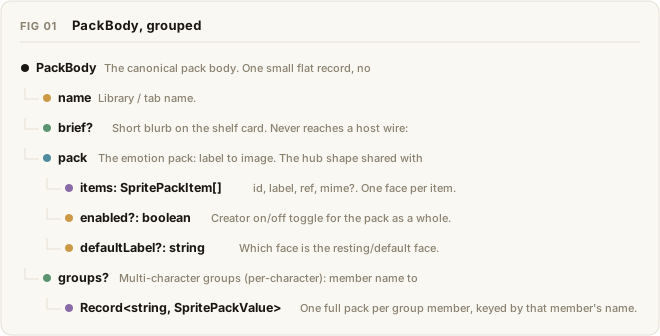
The table below is pasted verbatim from docs/generated/fields.pack.md.
Pack body
| Field | Type | Producers | Meaning |
|---|---|---|---|
name |
string |
- | Library / tab name |
brief? |
string |
- | Short blurb on the shelf card (never host wire) |
pack |
SpritePackValue |
- | The emotion pack (label -> image). Hub shape shared with character media. |
groups? |
Record<string, SpritePackValue> |
- | Optional multi-character groups (per-character); flat pack is the default group. |
The sprite pack hub shape
SpritePackValue (src/core/media/pack.ts) is the label-to-image hub every pack-shaped field converts
through, on a character card and in the library alike:
items: SpritePackItem[], the faces. Each item is{ id: string; label: string; ref: string; mime?: string }: a stable id, the display label ("neutral", "happy", ...), arefinto the entity's asset
store or a data URI, and an optional mime type.enabled?: boolean, a creator on/off toggle for the pack as a whole.defaultLabel?: string, which face is the resting/default face.resolvePackFacefalls back to a
face literally labelled "neutral", then to the first item, when this is absent or matches nothing.
A pack is not only pictures. An item whose media type is audio is a sound file, and the Stage wing's Music tab plays the sounds in the person's packs (a pack stands where RoleCall
has a category). The same item shape holds it, with mime an audio/* type: mp3, ogg, m4a, wav, flac or aac, sniffed from the bytes when it is added, and held to the media cap
of 32 MiB (ASSET_MAX_BYTES, src/core/media/limits.ts), not the 10 MiB picture limit. A sound is served from /api/asset/<sha>, which answers Range requests (206 with Content-Range, 416 for a range past the end, Accept-Ranges: bytes) so a browser can seek.
The store seals each file as one cell, so a range is cut from a single read bounded by that cap, not read from disk piece by piece; a 416 reads nothing (it is answered from the stored size), and a store that cannot report a size ignores Range and sends the whole file. Printing a pack writes its sounds
under the same cap, and importing the zip reads them back byte for byte: the image-pack codec and the pack editor's zip door take pictures (png, jpg, gif, webp, up to 10 MiB each)
and sounds (PACK_SOUND_EXTENSIONS, up to 32 MiB each), and a zip holding anything else is still not claimed. The pack editor draws a sound as a note glyph. Sounds are admitted by
extension and size on the inline path, and sniffed from their bytes when the editor stages them.
This is the same shape packFromMedia reads off a character's media.assets (role emotion) andemotionAssetsFromPack writes back onto, so a face pack means the same thing whether it lives on a
character card or as a standalone library pack entity.
groups?: Record<string, SpritePackValue> holds one full SpritePackValue per named group member,
keyed by that member's name: a multi-character scene, Lumiverse's expression_groups block
(src/formats/_shared/media-bridge/lumi-expressions.ts). When groups is absent or empty, pack alone
is the default group.
What rides escrow, not a field
The image-pack adapter records imported member filenames in its original entry. The media bytes
themselves become canonical item refs; the ZIP container is not retained. Studio-created packs still
start as a bare CanonicalEntity<"pack", PackBody> with no original entry.
The only imported escrow is the list of filenames used by the image-pack import. It is descriptive
metadata, not the source bytes or a promise of byte-identical container output.
Does NOT ride escrow, because there is nothing for it to carry: an item's ref (a data URI, or a
reference into the entity's asset store) is the image itself, authored inline, not a binary carrier kept
beside a canonical field the way a character's PNG sourceMedia carrier is. See architecture.md,
"Binary carriers", for the contrast.
See also
- architecture.md: the canonical model, the adapter contract, escrow.
- entities/character.md: the
Mediasection, and the character-attached form of this
sameSpritePackValuehub shape. - formats/README.md: the coverage matrix; pack import normalizes files directly
into the studio-native canonical shape rather than claiming external field coverage.