Docs / Developer / Backyard format
Backyard format
Backyard.ai (formerly Faraday.dev) has shipped two unrelated on-disk character shapes across its
lifetime. bunzai reads and writes both. Neither is a Tavern superset: each carries its own vocabulary, and
each is handled by its own adapter.
The format is one folder, src/formats/backyard/, whose index.ts default-exports two codecs
(index.ts:158-163):
backyard, kindcharacter, reads a flat JSON object (aiName/aiPersona/customDialogueera).
Writes.json.byaf, kindcharacter, reads a.byafZIP archive (manifest +characters/<id>/character.json+
one or morescenarios/*.json+ images). Writes.byaf.
This page documents both in full. For the canonical field meanings each maps onto, see
entities/character.md. For the hub-and-spoke, escrow, and detection model, see
architecture.md. For the whole matrix of formats, see
FORMAT-SUPPORT.md.

Detection
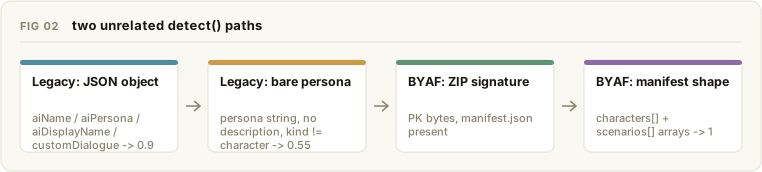
The registry runs every adapter's detect() and keeps the single highest score above 0.5, so a more
specific format still outranks a generic one on a shared input (architecture.md, "Detection and the
registry").
Legacy JSON
detect() reads only input.text, returning 0 immediately if there is no text, the text does not
parse as JSON, or the parsed value is not an object (index.ts:100-108). Otherwise it scores in two
tiers (index.ts:109-111):
0.9: any ofaiName,aiPersona,aiDisplayName,customDialogueis present as a string. These
keys are Backyard-unique, so a match is a confident identification.0.55:personais a string,descriptionisundefined, andkindis not"character". This is a
weak fallback for a stripped card carrying only apersonafield. The two extra guards exist so it does
not misfire:description === undefinedkeeps it off a flat card that pairspersonawithdescription, andkind !== "character"keeps it off an Agnai card, which setskind: "character".- Otherwise
0.
Both scores sit below the 1.0 adapters (RoleCall, Risu, Agnai) and the generic 0.9 Tavern reader on a
shared input. 0.55 clears the 0.5 recognition threshold but only just, by design.
BYAF
detect() reads only input.bytes. It returns 0 unless the bytes start with the ZIP local-file-header
signature PK (0x50 0x4b), then unzips just manifest.json, parses it, and checks that characters
and scenarios are arrays and characters[0] is a string; any failure at any step returns 0
(byaf.ts:288-301, readManifestBytes, byaf-container.ts:142-148). A match scores 1: unlike the
legacy adapter, there is no weaker fallback tier, because a ZIP carrying a schema-shaped manifest.json
is not ambiguous with any other format in the registry.
Field map
Legacy JSON
See entities/character.md for what each canonical slot means. Backyard uses
several alias keys per concept. Reads take the first non-empty string among a key list, firstStr
(index.ts:18-24). Text fields listed as "converted" run through placeholder conversion on the way in;
see Escrow and round-trip.
| Canonical | Legacy wire (first non-empty wins) | Converted | Notes |
|---|---|---|---|
identity.name |
aiDisplayName, aiName, displayName, name |
no | Defaults to "" when all four are absent. index.ts:44,51 |
identity.nickname |
aiName |
no | Carried only when it differs from the resolved name; see the two-names quirk below. index.ts:52-58 |
identity.description |
aiPersona, description, persona |
yes | index.ts:45,59 |
identity.characterVersion |
version |
no | Left unset if absent; no synthesized default at parse time. index.ts:61 |
persona.personality |
personality |
yes | index.ts:64 |
persona.scenario |
scenario |
yes | index.ts:65 |
prompts.systemPrompt |
systemPrompt, system_prompt |
yes | index.ts:48,67 |
greetings.firstMessage |
firstMessage, greeting, first_mes |
yes | index.ts:46,68 |
examples.exampleMessages |
customDialogue, examples, mes_example |
yes | index.ts:47,69 |
attribution.creator |
creator |
no | index.ts:71 |
discovery.tags |
tags |
no | Array; non-string entries are dropped. index.ts:72 |
Everything else in CharacterBody (taglines, prompts other than system, alternate greetings, media,
presentation, lorebook/behavior refs) is left unset by this adapter; if the source card carried anything
under other keys, it survives only through escrow.
The two Backyard name keys are distinct authored fields and are modeled that way: aiDisplayName is the
display name (identity.name), aiName is the {{char}} shorthand (identity.nickname), carried only
when it differs from the resolved name (index.ts:52-58). See Quirks for the export side of
this.
BYAF
See entities/character.md for what each canonical slot means. Container
parsing (open the ZIP, locate the manifest, character, and scenario files) lives in byaf-container.ts
and does no body mapping; the field map itself lives in byaf.ts's archiveToBody (byaf.ts:50-147).arc.scenarios[0] is always the primary scenario, taken in manifest array order. Unlike the legacy codec,
BYAF text fields carry over verbatim: there is no brace-placeholder conversion anywhere in byaf.ts orbyaf-scenarios.ts.
| Canonical | BYAF wire | Notes |
|---|---|---|
identity.name |
character.displayName, fallback character.name |
byaf.ts:53,115 |
identity.nickname |
character.name |
Carried only when it differs from the resolved display name. byaf.ts:54,116 |
identity.description |
character.persona |
Single field; there is no personality/description split, so persona.personality is left unset. byaf.ts:117 |
persona.scenario |
scenarios[0].narrative |
byaf.ts:120 |
prompts.systemPrompt |
scenarios[0].formattingInstructions |
byaf.ts:123 |
greetings.firstMessage |
scenarios[0].firstMessages[0].text |
byaf.ts:56,126 |
greetings.alternateGreetings[] |
extra scenarios[0].firstMessages[] entries, plus every later scenario's first message |
See below. byaf.ts:57-75 |
examples.exampleMessages |
scenarios[0].exampleMessages[].text, newline-joined |
byaf.ts:76,130 |
media.portrait |
the character.images[] entry labeled avatar (case-insensitive), else the first image |
byaf.ts:78-99 |
media.assets[] |
every other character.images[] entry |
Bytes are read from the archive and re-embedded as a data: URI; a row whose file is missing from the archive is skipped. byaf.ts:78-99 |
presentation.background |
scenarios[0].backgroundImage, if the path resolves in the archive |
Re-embedded as a data: URI. byaf.ts:101-108 |
attribution.creator |
manifest.author.name |
byaf.ts:138 |
attribution.sourceUrl |
manifest.author.backyardURL |
byaf.ts:139 |
attribution.createdAt |
character.createdAt, fallback manifest.createdAt |
ISO string parsed to unix seconds. byaf.ts:32-37,140 |
attribution.updatedAt |
character.updatedAt |
byaf.ts:141 |
discovery.rating |
character.isNSFW |
true maps to explicit, false to all-ages; the middle tier mature is never produced from BYAF, which only has a boolean. byaf.ts:111,144 |
character.loreItems[] is not mapped to a canonical lorebook reference by this adapter. It rides
untouched inside original.byaf.raw until a lore content-type projection is built (byaf-coverage.ts:36).
Sampler and runtime settings
(temperature, topP, topK, minP, minPEnabled, repeatPenalty, repeatLastN, promptTemplate,grammar, model), the scenario messages[] chat transcript, and every non-primary scenario's fields
other than its opening message stay on escrow only; none of it is first-classed canonical.
Alternate greetings: scenarios[0]'s own firstMessages beyond the first become untitled alternate
greetings. Every scenario after the first contributes one alternate greeting: its title is the scenario'snarrative, falling back to its title, and its text is that scenario's first message
(byaf.ts:56-75). Each alternate greeting gets a deterministic id minted from the archive-internal
scenario path, byaf:<path> or byaf:<path>#<index> for extra primary messages
(byaf-scenarios.ts:9-15), so re-importing the same archive yields identical ids and export can match a
titled alt back to its originating scenario file. See Quirks.
Escrow and round-trip
The escrow envelope is the canonical wrapper's original field, a Record<FormatId, OriginalEntry> keyed
by format id (canonical.ts:39-51,80). The architecture calls this concept "escrow"; the wrapper field is
named original. Legacy cards store their twin at original.backyard; BYAF archives store theirs atoriginal.byaf.
The whole raw parsed object rides in original.backyard.raw (index.ts:123). That escrow is what makes
round-trips safe, because the placeholder conversion below is not a bijection.
Backyard writes placeholders in single braces ({character} / {user}, and a bare {char}). The
canonical model uses Tavern double braces, so on import every text field is rewritten: {character} and{char} become {{char}}, {user} becomes {{user}} (toTavern, index.ts:32-36). The {char}
fallback uses lookarounds so it matches a genuine single brace and never the inner {char} of an
already-converted {{char}}. The inverse (toBackyard, index.ts:39-40) only handles {{char}} /{{user}} and drops any other Tavern token, so it is lossy.
On export (fromCanonical) the adapter clones the escrowed raw card, or starts from {} if there is no
escrow, and overlays the canonical body (index.ts:127-155). Per text field, fieldOut decides
(index.ts:82-87):
- If the field is unedited since parse (converting the raw string forward equals the current canonical
value), it re-emits the raw bytes verbatim, so the non-bijective conversion cannot corrupt an untouched
card. - If the field was edited, it writes a fresh single-brace conversion of the canonical value, which takes
the lossy inverse.
So an unedited legacy card survives a Backyard to canonical to Backyard round-trip with its text values
intact; only fields actually changed re-encode and risk placeholder loss.
The whole opened archive (manifest, character, every scenario, and every file's bytes as base64) rides inoriginal.byaf.raw (byaf.ts:313, archiveToOriginal, byaf-container.ts:84-97). On export,originalToArchive rebuilds the in-memory archive shape from that twin (byaf-container.ts:99-125), the
canonical body is overlaid onto it (applyBodyToArchive, byaf.ts:262-279), and packByaf re-serializesmanifest.json, character.json, and every scenario file as JSON and re-zips the whole file map
(byaf-container.ts:127-139). Sampler settings, the chat transcript, promptTemplate, and grammar are
never read by applyBodyToArchive, so they ride the twin through untouched (byaf.test.ts:74-86
exercises this directly).
Media follows the same unedited-vs-edited split as legacy text: a portrait, gallery asset, or background
re-opened from the archive round-trips as a data: URI, and re-writing that same URI back is safe; only a
genuinely new or cleared image touches the archive's images[] rows and files
(applyMediaToArchive, byaf.ts:173-260). Clearing every image deletes the character's images/ files
from the archive, not just the images[] rows; clearing the background does the same forbackgroundImage, unless another scenario still references the same file (byaf.ts:184-191,247-259).
Alternate greetings round-trip through the stable per-scenario id, not through title matching alone: on
export, an alt whose id resolves to a known archive-internal scenario path is written back into that exact
scenario file (preserving its chat transcript, sampler knobs, and grammar); only an alt with no resolvable
id and a title is matched by title against an unused secondary scenario, or else becomes a freshly mintedscenarios/scenarioN.json (byaf-scenarios.ts:82-120; scenarioFromAlt). A secondary scenario whose alt
was removed from the edited list is deleted from the archive as an orphan (byaf-scenarios.ts:178-180).
An id is only ever resolved to a path when that path is already present in the twin; a hostile or
malformed id (path traversal, an unknown path) never becomes a filesystem write
(resolveGreetingPath, byaf-scenarios.ts:21-35).
A from-scratch canonical character with no original.byaf twin gets a minimal manifest, character, and
single scenario shell synthesized before the same applyBodyToArchive overlay runs, so BYAF export never
requires a source BYAF archive to have existed (byaf.ts:317-363).
Quirks
- Two names, two keys.
aiDisplayName/character.displayNameis the display name
(identity.name);aiName/character.nameis the{{char}}shorthand (identity.nickname). An
earlier version of the legacy adapter folded both intoidentity.nameand stamped the same value onto
both keys on export, destroying a distinct authoredaiNameon every round-trip; this was a fix with a
regression test (index.ts:132-137,backyard.test.ts:94-113, "WB-1"). BYAF'sapplyBodyToArchive
applies the identical rule (byaf.ts:265-266). - No version fabrication. Legacy
versionis left unset at parse time if the source omitted it, and
export never invents one onto an existing twin; only a from-scratch cross-format card (nooriginal.backyard) gets a"1.0"floor so it still emits valid JSON (index.ts:149-152,backyard.test.ts:115-119). - BYAF's boolean rating is lossy toward canonical, not away from it.
character.isNSFWonly has two
states, so canonical's middlematuretier can never come from a BYAF import. Export only writesisNSFWfor an exact"explicit"or"all-ages"match; amaturerating (or one arriving from a
richer cross-format source) falls into neither branch and leaves the archive twin's existingisNSFW
untouched, while a from-scratch character with no twin defaultsisNSFWtofalsefor anything but"explicit"(byaf.ts:268-269,328). - BYAF has one character per archive. The manifest's
charactersarray is read ascharacters[0]only
(byaf-container.ts:56); the ahoylabs spec itself caps the array at one entry, so this is not a
simplification bunzai made, it is the format. - Untitled vs titled alternate greetings take different archive homes. An alt with no title is folded into
the primary scenario's ownfirstMessages[]; an alt with a title becomes (or updates) its own secondaryscenarios/*.jsonfile. Retitling an alt does not move it between the two homes on its own, only its
resolvable id and whether the edited title is blank decide that
(byaf-scenarios.ts:127-148). - BYAF detect has no weak tier. Unlike the legacy adapter's
0.55fallback, a.byafeither has a
ZIP-with-manifest shape scoring1, or it scores0. There is no ambiguous middle case in this
registry (byaf.ts:288-301). creatorandtagsbypass placeholder conversion. Both directions copy them straight through on the
legacy adapter;tagsis only written on export when the canonical value is present (index.ts:71-72,147-148).
Source of truth
| Concern | File |
|---|---|
| Legacy adapter (detect, toCanonical, fromCanonical) | src/formats/backyard/index.ts |
| Legacy coverage declaration | src/formats/backyard/coverage.ts |
| BYAF adapter (detect, toCanonical, fromCanonical) | src/formats/backyard/byaf.ts |
| BYAF ZIP container (open, pack, original twin) | src/formats/backyard/byaf-container.ts |
| BYAF scenario/greeting id mapping | src/formats/backyard/byaf-scenarios.ts |
| BYAF coverage declaration | src/formats/backyard/byaf-coverage.ts |
Canonical wrapper, escrow (original), id policy |
src/core/canonical.ts |
| Samples | samples/backyard/{1,2,3}.byaf (ahoylabs/byaf's own conformance archives; no clean public legacy-JSON sample found, so that shape is fixtured only in backyard.test.ts) |