Docs / Developer / Regex entity
Regex entity
A CanonicalRegexSet is CanonicalEntity<"regex", RegexSetBody>: the stable canonical wrapper (see
architecture.md) around a RegexSetBody, the superset shape that unions what
every real find/replace-script format expresses. src/entities/regex/schema.ts is the source of truth
for the types; this page is the source of truth for what each field MEANS and which formats produce it.
A regex set is a named, ordered collection of rules. One rule maps 1:1 to a SillyTavern script
row, a Risu customscript row, a RoleCall rule, a Lumiverse script, or a Marinara script; one set maps to
an ST standalone file or card bundle, an RC script, a Lumiverse folder/pack slice, a Risu card/module list,
or a Marinara collection. A set stores under studio/regex/<id>.json, the same hub-and-spoke shape as
the lorebook, persona, and pack entities.
A rule is DATA. Applying one is a budgeted String.replace, never eval; see
concepts/regex-engine.md for the pipeline that runs it and
concepts/regex-editor.md for the Workbench room that authors it.
How to read the field tables
The field tables on this page are generated from the schema by scripts/docs-fields.ts and embedded
verbatim. Do not hand-edit a cell: improve the schema doc comment and regenerate, and the docs follow.
- Field is the canonical name. A trailing
?marks an optional field. - Type is the TypeScript type in the schema.
- Producers are the source formats named in the field's schema doc comment. A
-means the doc
comment names no specific producer. Many such fields are the universal core every rule carries
(id,label,find,flags,replace,phases,enabled,sortOrder); others simply have
their provenance described in prose rather than tagged inline. - Meaning is what the field is for. A blank Meaning cell is a self-evident primitive named by its
own field, and marks a field the schema doc comment did not annotate. Non-obvious fields carry their
meaning from the schema doc comment. Any richer explanation lives in the prose around a table, never
inside a cell.
Composition
RegexSetBody is small: a name, an optional description, a set-level enabled switch, and the orderedrules list. Nearly all of the entity's surface lives inside RegexRule, a flat interface whose 21
fields still read as three concerns: identity and content (what the rule is and does), placement (when
and where it runs in the pipeline), and vaud-engine-only controls (behavior no wire format can carry).RegexRuleCondition is a small nested shape used by one field, condition.
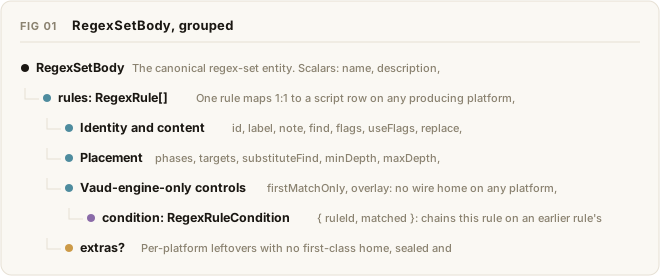
The sections below walk each shape. Every field table is pasted verbatim from
docs/generated/fields.regex.md.
The set
RegexSetBody is the top-level shape: the set's own name and description, its on/off switch, and the
rule list.
| Field | Type | Producers | Meaning |
|---|---|---|---|
name |
string |
- | |
description? |
string |
- | |
enabled? |
boolean |
- | Set-level on/off (the Library shelf's enable switch; the lorebook enabled? precedent). Absent = on; always read as enabled !== false. An off set skips export the way an off lorebook does. Additive and optional so the risu character codec and the in-flight set editor stay compatible. |
rules |
RegexRule[] |
- |
The rule
find and flags are stored separately (the Risu/RC/Lumiverse encoding); the SillyTavern codec
folds/unfolds its single /pattern/flags wire string on import and export. flags is stored
verbatim, including Risu extension tokens observed live ("gu<cbs>"), never stripped except at
compile time inside the engine.
Reading down the table below: id through trimStrings is identity and content, phases throughcharacterIds is placement, firstMatchOnly through overlay are the three vaud-engine-only
controls, enabled and sortOrder are the rule's own membership state, and extras is the escrow
bag (see What rides escrow, not a field below).
| Field | Type | Producers | Meaning |
|---|---|---|---|
id |
string |
- | stable rule id, preserved across round-trips |
label |
string |
- | |
note? |
string |
Lumiverse | internal creator note; distinct from label (Lumiverse description) |
find |
string |
- | bare pattern, NO delimiters |
flags |
string |
- | verbatim flags string; default "g"; may carry non-JS extension tokens |
useFlags? |
boolean |
Risu | Risu ableFlag: whether the custom flags string applies |
replace |
string |
- | verbatim; may carry $1/{{match}}/CBS/HTML - render only through SealedHtmlPreview |
trimStrings? |
string[] |
RC, ST | ST/RC/Lumiverse: fragments stripped from the match before replace |
phases |
RegexPhase[] |
- | |
targets? |
RegexTargetChannel[] |
Lumiverse | Lumiverse's placement x target matrix; absent = platform default |
substituteFind? |
RegexSubstitution |
- | find-side macro substitution mode; absent = "none" |
minDepth? |
number | null |
RC, ST, Marinara | ST/RC/Lumiverse/Marinara depth window (message depth, 0 = most recent; exact counting differs per platform) |
maxDepth? |
number | null |
- | |
runOnEdit? |
boolean |
RC, ST | ST/RC/Lumiverse: re-apply this rule when a message is edited |
characterIds? |
string[] |
Marinara | Marinara targetCharacterIds: limit to specific recipient characters; empty/absent = all |
firstMatchOnly? |
boolean |
- | Vaud-engine-only (R2X, no wire home anywhere - travel lint marks these three under every platform lens; export keeps the data canonical-side and emits nothing): replace only the FIRST match even under a global flag. |
condition? |
RegexRuleCondition |
- | Vaud-engine-only: run only when another rule in this set did (or did not) apply this pass. |
overlay? |
boolean |
ST | Vaud-engine-only: display-channel rule that returns match spans + replacement as an OVERLAY instead of mutating text (ST names this "Overlay strategy" and implements it nowhere). |
enabled |
boolean |
- | |
sortOrder |
number |
- | |
extras? |
Record<string, unknown> |
ST | Per-platform leftovers with no first-class home (Lumiverse telemetry/scope/script_id, ST id/uuid, ...). Sealed, round-trips untouched - the lossless-escrow doctrine. |
Rule chaining
condition is the only field that reaches for a nested shape. It chains a rule's own firing on
whether an EARLIER rule in the same set did, or did not, apply on the same pass: one pass, sortOrder
order, never a forward reference. A ruleId naming a rule that has not run yet, or does not exist,
skips the carrying rule with an honest trace reason instead of guessing.
| Field | Type | Producers | Meaning |
|---|---|---|---|
ruleId |
string |
- | |
matched |
boolean |
- |
The character-card twin
CharacterRegexScript (same file, src/entities/regex/schema.ts) is the narrow, card-embedded RisucustomScripts shape: singular phase instead of phases, and no id / enabled / sortOrder,
because the card wire has none of those. entities/character/schema.ts re-exports this type as its
own RegexScript so there is one definition, not two independently maintained shapes. It is
deliberately NOT RegexRule itself: a full alias would change CharacterBehavior.regexScripts's wire
contract and break the Risu codec's round-trip. It stays the small card-embedded twin until a real
migration replaces customScripts with references to standalone regex entities. See
entities/character.md, section CharacterBehavior.
| Field | Type | Producers | Meaning |
|---|---|---|---|
label? |
string |
- | |
find |
string |
- | |
replace |
string |
- | |
phase |
string |
- | pipeline phase, open union: "edittrans" | "editoutput" | "editdisplay" | ... |
flags? |
string |
Risu | custom regex flags (Risu flag) |
useFlags? |
boolean |
Risu | whether the custom flags apply (Risu ableFlag) |
What rides escrow, not a field
Anything a single source format keeps but no canonical field expresses stays in escrow[formatId].raw
and survives a same-format round-trip byte-for-byte, the same doctrine every entity follows (see
architecture.md). For the SillyTavern codec this isoriginal["sillytavern-regex"], the raw script rows kept for exact re-projection on export.
A second, finer-grained mechanism sits at the rule level. extras is itself a canonical field onRegexRule, not the entity envelope: it seals per-platform leftovers with no first-class slot
(Lumiverse telemetry, scope, script_id; SillyTavern id, uuid; any wire key the schema does not
model) and re-merges them onto the wire untouched on export. It rides in the schema, at row grain,
rather than in one whole-file original snapshot, because different rules in the same set can carry
different unrecognized keys, and an edited or reordered rule still needs its own leftovers to
re-emit correctly, not just an unedited file replayed verbatim.
Does NOT ride escrow, because it is modeled: firstMatchOnly, condition, and overlay have no wire
home on ANY platform (travel-lint marks all three under every platform lens), but they are first-classed
canonical fields, not escrow. They are vaud-engine-only controls the Workbench editor can set andapplyRules (core/regex/apply.ts) actually executes; export simply emits nothing for them on a
format that cannot carry them.
Where a scene uses a set
A scene switches library sets on one by one (the Final Cut wing's Regex tab; Chat.regex.sets, ChatStore rule 42), and they run in the
order they were switched on, each set's rules by sortOrder. Two phases matter there, RoleCall's two live placements: display
(display_only, drawn on stable messages, never stored; depth 0 is the last message of the take) and prompt (prompt_only, the
conversation messages of the request a turn sends; depth 0 is the message being answered). A rule's targets are honoured (display andprompt respectively), a disabled rule or set is skipped, and a prompt rule that names message_roles (kept in extras, as RoleCall's wire
carries it) runs for those roles only. The input, output, lorebook and reasoning phases are not run by a scene. Every run is in the
sandbox worker; see regex-safety.md.
See also
- architecture.md: the canonical model, escrow, hub-and-spoke, the adapter contract.
- entities/character.md: the
CharacterBehavior.regexScriptsfield, and theRegexScriptcard twin this page defines. - concepts/regex-engine.md: how a rule set actually runs (
applyRules, the AST layer, travel-lint). - concepts/regex-editor.md: the Workbench authoring surface, its three modes, and the test bench.
- formats/README.md: the coverage matrix of every format and the fields it produces.